



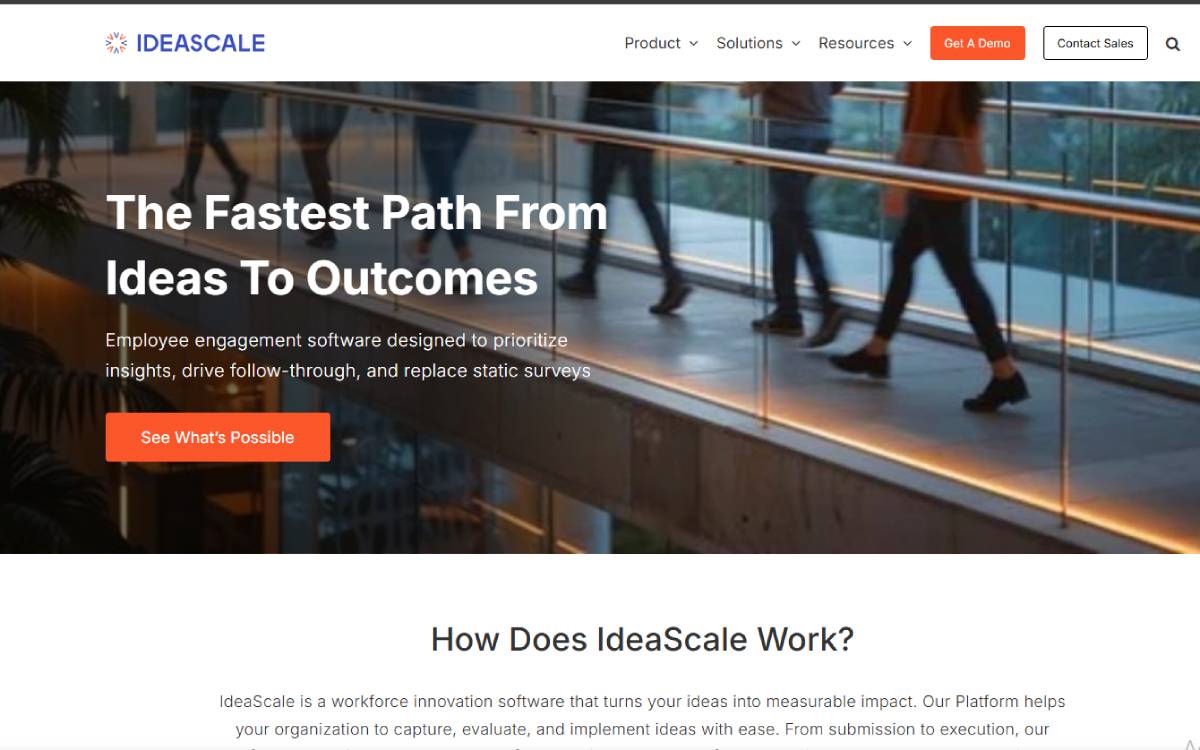
IdeaScale is strengthening its innovation-management platform with a greater emphasis on artificial intelligence, structured collaboration and measurable outcomes. The development reflects a broader shift among enterprises toward using technology to move beyond idea collection and improve evaluation, prioritization and implementation. The trend has growing relevance for executives managing innovation, transformation and organizational performance.
IdeaScale combines idea generation, evaluation, collaboration, implementation tracking and analytics within a centralized innovation-management platform. Its AI capabilities are designed to assist organizations in analyzing innovation data, improving idea submissions and helping administrators access information more efficiently.
The platform also supports configurable workflows, reporting, dashboards and integrations intended for organizations managing innovation across multiple teams or business units. Its customer base includes enterprises and government organizations, positioning the platform for large-scale innovation programs.
The strategic direction is increasingly centered on connecting employee and customer participation with business priorities, rather than treating innovation as a standalone brainstorming exercise.
The development comes as businesses face increasing pressure to demonstrate measurable returns from innovation investments. Traditional suggestion programs can generate significant volumes of ideas, but executives often struggle to determine which proposals deserve resources and how successful initiatives should be tracked.
AI is changing that equation by allowing organizations to process larger amounts of qualitative information, identify recurring themes and accelerate early-stage evaluation. Innovation-management platforms are consequently evolving from digital suggestion boxes into broader systems for strategic decision-making.
IdeaScale's positioning reflects this industry transition. By bringing together ideation, evaluation, collaboration, analytics and implementation processes, the company is targeting organizations seeking a more structured innovation lifecycle. The approach is particularly relevant to large enterprises and public-sector institutions where innovation programs can involve thousands of participants, multiple stakeholders and complex approval structures.
IdeaScale has consistently positioned innovation management around the principle of turning collective intelligence into actionable organizational outcomes. Its platform strategy emphasizes helping organizations capture ideas, evaluate opportunities and move promising concepts toward implementation.
The growing use of AI introduces another layer to that process. AI-assisted analysis can help innovation teams identify patterns across large numbers of submissions, while writing and collaboration tools can improve the quality and consistency of contributions.
For executives, however, automation does not eliminate the need for human judgment. Strategic priorities, funding decisions, risk assessments and final implementation choices remain dependent on organizational leadership. The most effective innovation programs are therefore likely to combine AI-supported analysis with clearly defined governance, human oversight and measurable performance criteria.
This balance will be particularly important for government organizations and highly regulated industries, where transparency and accountability can be as important as speed. For businesses, the shift toward AI-driven innovation management could improve how organizations identify opportunities, allocate resources and measure innovation performance. Companies may gain greater visibility into which ideas align with strategic priorities and which initiatives are progressing toward implementation.
For investors and executives, the broader significance lies in the potential to connect innovation activity with measurable commercial outcomes. Instead of focusing primarily on the number of ideas submitted, leadership teams can increasingly evaluate conversion rates, implementation progress and business impact.
Government organizations could also benefit from structured mechanisms for collecting and evaluating ideas from employees and broader communities. At the same time, policymakers and executives will need to consider data governance, AI transparency, security and accountability as these technologies become embedded in organizational decision-making.
IdeaScale's development reflects a wider enterprise technology trend in which AI is moving from an experimental capability toward an operational layer within business processes. The next stage will likely involve deeper automation across idea analysis, prioritization, collaboration and implementation.
Decision-makers should watch whether AI-enabled innovation platforms can demonstrate tangible improvements in speed, quality and return on innovation investment. Ultimately, the competitive advantage will belong to organizations that can consistently convert promising ideas into measurable results.
Source: Crozdesk, IdeaScale
Date: August 11, 2026


