
IBM CEO Backs US AI Order

IBM CEO Arvind Krishna has voiced support for a revised, more focused AI executive order associated with former President Donald Trump’s policy framework, according to industry reporting.

June 4, 2026
|
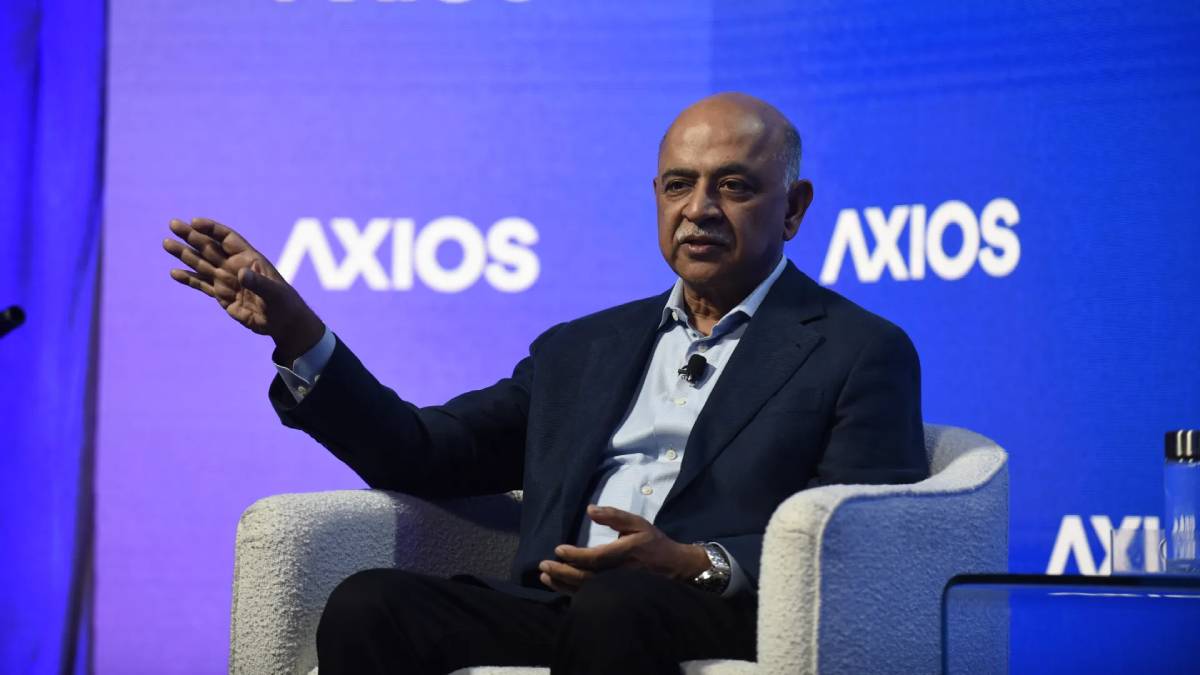
Image Source: Axios

A renewed debate over U.S. artificial intelligence governance is intensifying after IBM’s chief executive publicly backed a narrowed version of a presidential AI executive order. The move signals growing industry alignment with targeted regulation rather than sweeping restrictions, with implications for technology firms, policymakers, and global AI competition.

IBM CEO Arvind Krishna has voiced support for a revised, more focused AI executive order associated with former President Donald Trump’s policy framework, according to industry reporting. The updated directive reportedly scales back earlier, broader regulatory provisions in favor of narrower compliance and transparency requirements.

The endorsement positions IBM alongside major enterprise tech players advocating predictable governance structures to accelerate AI deployment. The policy discussion comes as Washington intensifies scrutiny of frontier AI systems, including model safety, export controls, and enterprise adoption standards. The shift also reflects lobbying pressure from cloud and AI infrastructure providers seeking regulatory certainty while maintaining innovation momentum in global markets.

The debate over U.S. AI regulation has accelerated as generative and agentic AI systems become embedded across enterprise workflows. Earlier regulatory proposals in Washington focused heavily on safety testing, model transparency, and potential licensing frameworks for advanced systems. However, industry leaders have increasingly argued that overly broad rules could slow innovation and weaken U.S. competitiveness against China and other AI-advancing economies.

IBM, a long-standing enterprise technology provider, has consistently advocated for “governed innovation” rather than restrictive oversight. The company’s position reflects a wider industry trend where cloud providers, chipmakers, and AI developers are pushing for standardized but flexible compliance regimes. The policy environment remains fragmented, with overlapping federal proposals and state-level AI rules creating complexity for global technology firms operating across jurisdictions.

Policy analysts suggest IBM’s endorsement highlights a strategic convergence between enterprise AI providers and policymakers seeking pragmatic regulation. Experts note that companies with large-scale enterprise AI deployments benefit from clearer, narrower compliance frameworks that reduce legal uncertainty while preserving product velocity.

Industry observers also point out that AI governance is increasingly becoming a competitive geopolitical issue, with the U.S. aiming to balance innovation leadership against systemic risk controls. Some regulatory scholars caution that narrowing executive orders could weaken safeguards around model misuse, misinformation, and autonomous system deployment.

While IBM has not released detailed public commentary beyond its policy positioning, analysts interpret the stance as aligned with broader industry lobbying efforts advocating risk-based, sector-specific oversight rather than blanket regulatory mandates.

For enterprises, a narrowed AI executive order could reduce compliance costs and accelerate deployment of AI agents in finance, healthcare, and cloud infrastructure. Investors may view regulatory clarity as a positive catalyst for AI-related equities, particularly enterprise software and infrastructure providers.

However, policymakers face the challenge of balancing innovation with systemic risk management, especially as AI systems gain autonomy in decision-making processes. Governments may also need to coordinate internationally to avoid fragmented regulatory regimes. For global executives, the shift signals a potential move toward market-driven AI governance models, where industry standards play a larger role than centralized regulation in shaping deployment norms.

Attention now turns to how the revised executive order is formalized and whether it gains bipartisan durability in Congress. Key uncertainties remain around enforcement mechanisms and alignment with international AI safety frameworks. Stakeholders will closely watch whether industry-backed regulatory narrowing accelerates AI commercialization or triggers renewed political pushback over oversight gaps.

Source: Axios
Date: June 3, 2026

  • Featured tools
Symphony Ayasdi AI
Free

SymphonyAI Sensa is an AI-powered surveillance and financial crime detection platform that surfaces hidden risk behavior through explainable, AI-driven analytics.

#
Finance
Learn more
Upscayl AI
Free

Upscayl AI is a free, open-source AI-powered tool that enhances and upscales images to higher resolutions. It transforms blurry or low-quality visuals into sharp, detailed versions with ease.

#
Productivity
Learn more

Learn more about future of AI

Join 80,000+ Ai enthusiast getting weekly updates on exciting AI tools.
Thank you! Your submission has been received!
Oops! Something went wrong while submitting the form.

IBM CEO Backs US AI Order

June 4, 2026

IBM CEO Arvind Krishna has voiced support for a revised, more focused AI executive order associated with former President Donald Trump’s policy framework, according to industry reporting.

Image Source: Axios

A renewed debate over U.S. artificial intelligence governance is intensifying after IBM’s chief executive publicly backed a narrowed version of a presidential AI executive order. The move signals growing industry alignment with targeted regulation rather than sweeping restrictions, with implications for technology firms, policymakers, and global AI competition.

IBM CEO Arvind Krishna has voiced support for a revised, more focused AI executive order associated with former President Donald Trump’s policy framework, according to industry reporting. The updated directive reportedly scales back earlier, broader regulatory provisions in favor of narrower compliance and transparency requirements.

The endorsement positions IBM alongside major enterprise tech players advocating predictable governance structures to accelerate AI deployment. The policy discussion comes as Washington intensifies scrutiny of frontier AI systems, including model safety, export controls, and enterprise adoption standards. The shift also reflects lobbying pressure from cloud and AI infrastructure providers seeking regulatory certainty while maintaining innovation momentum in global markets.

The debate over U.S. AI regulation has accelerated as generative and agentic AI systems become embedded across enterprise workflows. Earlier regulatory proposals in Washington focused heavily on safety testing, model transparency, and potential licensing frameworks for advanced systems. However, industry leaders have increasingly argued that overly broad rules could slow innovation and weaken U.S. competitiveness against China and other AI-advancing economies.

IBM, a long-standing enterprise technology provider, has consistently advocated for “governed innovation” rather than restrictive oversight. The company’s position reflects a wider industry trend where cloud providers, chipmakers, and AI developers are pushing for standardized but flexible compliance regimes. The policy environment remains fragmented, with overlapping federal proposals and state-level AI rules creating complexity for global technology firms operating across jurisdictions.

Policy analysts suggest IBM’s endorsement highlights a strategic convergence between enterprise AI providers and policymakers seeking pragmatic regulation. Experts note that companies with large-scale enterprise AI deployments benefit from clearer, narrower compliance frameworks that reduce legal uncertainty while preserving product velocity.

Industry observers also point out that AI governance is increasingly becoming a competitive geopolitical issue, with the U.S. aiming to balance innovation leadership against systemic risk controls. Some regulatory scholars caution that narrowing executive orders could weaken safeguards around model misuse, misinformation, and autonomous system deployment.

While IBM has not released detailed public commentary beyond its policy positioning, analysts interpret the stance as aligned with broader industry lobbying efforts advocating risk-based, sector-specific oversight rather than blanket regulatory mandates.

For enterprises, a narrowed AI executive order could reduce compliance costs and accelerate deployment of AI agents in finance, healthcare, and cloud infrastructure. Investors may view regulatory clarity as a positive catalyst for AI-related equities, particularly enterprise software and infrastructure providers.

However, policymakers face the challenge of balancing innovation with systemic risk management, especially as AI systems gain autonomy in decision-making processes. Governments may also need to coordinate internationally to avoid fragmented regulatory regimes. For global executives, the shift signals a potential move toward market-driven AI governance models, where industry standards play a larger role than centralized regulation in shaping deployment norms.

Attention now turns to how the revised executive order is formalized and whether it gains bipartisan durability in Congress. Key uncertainties remain around enforcement mechanisms and alignment with international AI safety frameworks. Stakeholders will closely watch whether industry-backed regulatory narrowing accelerates AI commercialization or triggers renewed political pushback over oversight gaps.

Source: Axios
Date: June 3, 2026

Promote Your Tool

Copy Embed Code

Similar Blogs

June 4, 2026
|

Amazon Ring Faces Facial Recognition Scrutiny

Amazon’s Ring division is facing allegations that its facial recognition and AI-based monitoring features may violate privacy laws.
Read more
June 4, 2026
|

Microsoft Ends Office 2019 Mac Support

Microsoft has confirmed that Office 2019 for Mac will no longer receive a necessary update, limiting user functionality to read-only mode for certain file operations.
Read more
June 4, 2026
|

Apple iPhone Fold Enters Foldable Race

The anticipated iPhone Fold is expected to represent Apple’s first entry into the foldable smartphone category, a segment currently dominated by competing Android manufacturers.
Read more
June 4, 2026
|

Polaroid Launches Go Gen 3 Camera

The new Polaroid Go Generation 3 camera introduces incremental upgrades to the company’s compact instant camera lineup, focusing on portability, ease of use, and enhanced image output.
Read more
June 4, 2026
|

Supernatural VR Fitness Returns Independent Platform

Supernatural, a leading VR fitness application, is re-emerging as a standalone platform outside of major corporate ownership.
Read more
June 4, 2026
|

AI Progress Reveals Limits Transformation Promise

Recent analysis around AI development points to a widening gap between expectations and measurable economic outcomes. While models continue to improve in reasoning, generation, and automation tasks.
Read more