



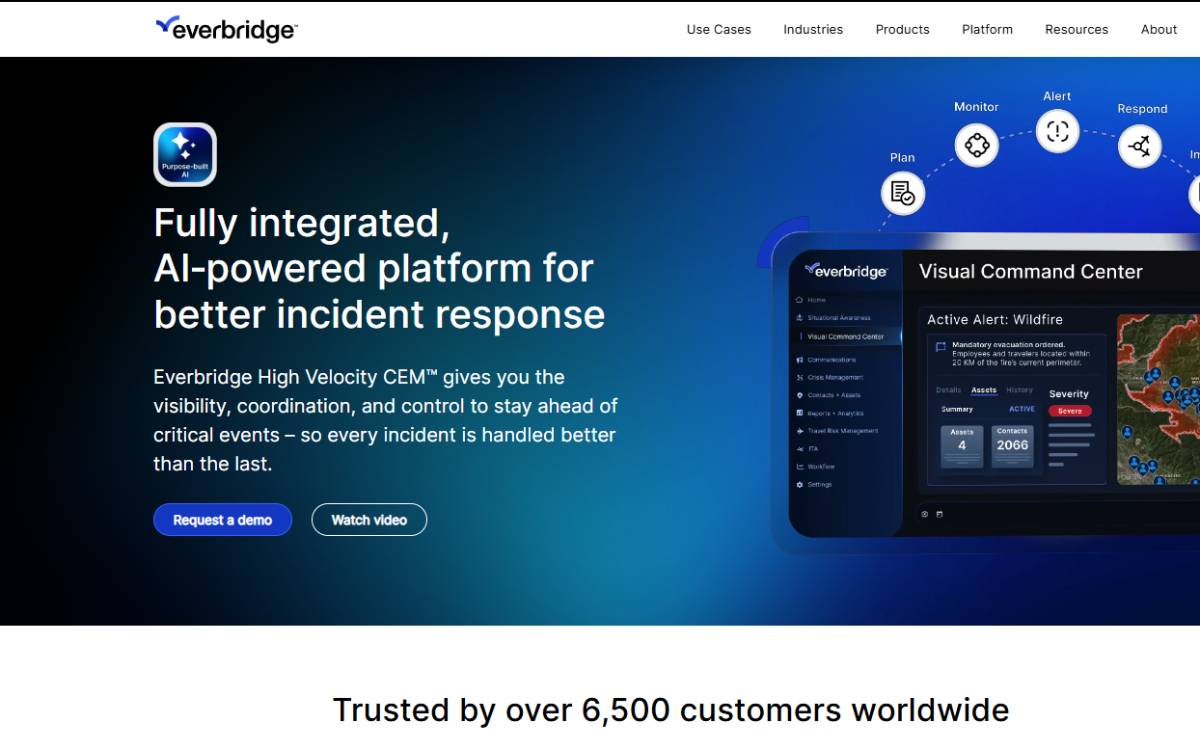
Everbridge highlights the growing importance of critical event management as organizations face increasingly complex operational, environmental, and security disruptions. By supporting emergency communications and coordinated response workflows, the platform reflects a broader enterprise shift toward resilient operations, helping businesses and public-sector organizations communicate quickly when unexpected events threaten people, assets, or continuity.
Everbridge operates in the critical event management and mass notification technology landscape, where organizations require rapid communication during emergencies and operational disruptions. Its capabilities are relevant to enterprises, government agencies, healthcare organizations, and other institutions managing geographically distributed workforces and assets.
The platform's broader role centers on helping organizations communicate information, coordinate responses, and maintain awareness during critical situations. Such capabilities can support incident response teams dealing with severe weather, security events, infrastructure disruptions, workplace incidents, or other emergencies.
For executives, the significance extends beyond communication. Effective notification and coordination can form part of a broader business-continuity strategy designed to reduce disruption and protect employees, customers, and critical operations.
The development aligns with a wider global trend toward enterprise resilience. Climate-related events, geopolitical instability, cybersecurity incidents, public-health emergencies, and infrastructure disruptions have increased pressure on organizations to prepare for increasingly varied operational risks.
Traditional emergency communication methods can become inadequate when organizations operate across multiple locations and employ increasingly distributed workforces. Executives therefore require systems capable of delivering timely information while supporting coordinated decision-making across departments and geographic regions.
Critical event management has consequently evolved from a specialized emergency-response function into a broader component of enterprise risk management. Organizations increasingly connect incident communication with business continuity, employee safety, operational resilience, and crisis governance.
Everbridge sits within this expanding technology category, where the ability to rapidly identify, communicate, and respond to disruptions can influence how effectively organizations protect people and maintain essential operations.
Industry analysts generally view critical event management as an increasingly important layer of organizational resilience. From an executive perspective, the effectiveness of such technology depends not only on the speed of notifications but also on the quality of information, communication reach, workflow coordination, and integration with existing operational systems.
Enterprise leaders are likely to evaluate platforms such as Everbridge based on their ability to support complex incident scenarios and connect different stakeholders during rapidly changing situations. The technology becomes particularly valuable when organizations need to coordinate employees, security teams, facilities managers, executives, and external responders.
Experts also emphasize the importance of preparedness before an incident occurs. Communication technology can support resilience, but organizations still need clearly defined response procedures, trained personnel, reliable data, and tested contingency plans. Technology is most effective when integrated into a broader crisis-management framework.
For global executives, critical event management can strengthen preparedness for disruptions that could affect employees, facilities, supply chains, and customer operations. Businesses may use these capabilities to improve emergency communication, accelerate response coordination, and reduce operational uncertainty during crises.
For investors, resilience technology represents part of the broader enterprise risk-management market, particularly as organizations place greater emphasis on continuity and workforce safety. Public-sector agencies can also benefit from coordinated communication during emergencies affecting communities.
Policy considerations remain significant. Organizations handling employee and location information must address privacy, security, access controls, and data governance. Governments and regulated industries may also face increasing expectations around emergency preparedness and timely communication.
The critical event management market is likely to evolve toward greater automation, predictive intelligence, and integration with enterprise security and operational systems. Decision-makers should watch how organizations connect crisis communications with broader resilience strategies and whether emerging technologies can improve response speed and decision quality. As disruption becomes a more persistent business risk, effective communication infrastructure is likely to remain central to enterprise preparedness.
Source: Crozdesk
Date: August 12, 2026


