
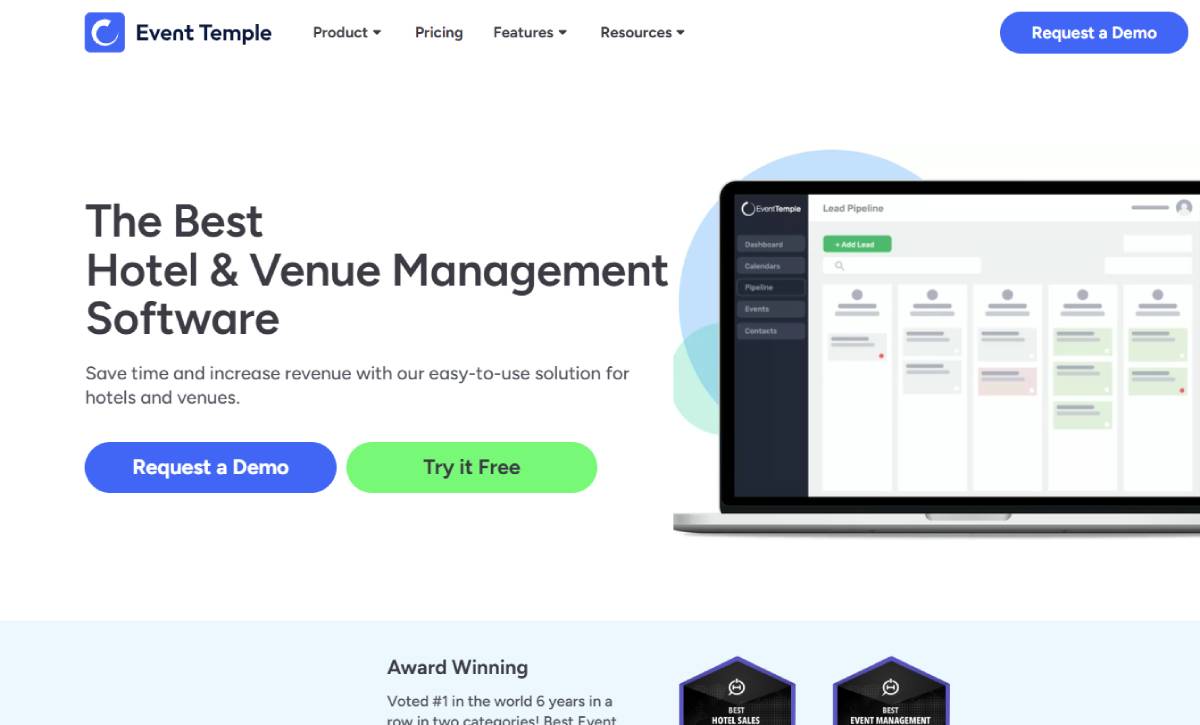
Event Temple Advances Digital Management

Event Temple provides a centralized platform for managing event sales, proposals, bookings, contracts, payments and operational workflows.

August 11, 2026
|

Event Temple is advancing the digital transformation of event and hospitality management with technology designed to streamline venue sales, event bookings, planning and customer engagement. Its integrated approach addresses growing demand for connected event-management workflows, helping hospitality businesses improve operational efficiency, strengthen client relationships and make faster, data-driven commercial decisions.

Event Temple provides a centralized platform for managing event sales, proposals, bookings, contracts, payments and operational workflows. The system is designed for hotels, venues and hospitality organizations that need to coordinate multiple stages of the event lifecycle from a single digital environment.

By connecting sales and event-management activities, the platform can reduce manual administration and improve visibility across bookings and customer interactions. Digital workflows also support more consistent communication between sales teams, event planners and venue operations.

The platform's positioning reflects increasing demand for specialized software capable of replacing fragmented spreadsheets, emails and disconnected processes with a more structured technology environment.

The events and hospitality sector is undergoing a significant technology transition as businesses seek to modernize processes while responding to changing customer expectations. Event organizers increasingly expect faster proposals, convenient digital communication, transparent booking processes and responsive service throughout the customer journey.

For hospitality operators, managing events can involve numerous stakeholders, including sales teams, planners, venue staff, clients and external suppliers. Without connected systems, information can become fragmented, creating administrative delays and increasing the risk of communication errors.

Event Temple's approach fits into the wider movement toward cloud-based vertical software that combines operational management with customer relationship capabilities. Such platforms are becoming increasingly important as hospitality businesses seek greater control over revenue pipelines and event performance.

The broader shift also reflects a move from basic administrative software toward integrated digital ecosystems capable of supporting end-to-end business operations. Industry observers increasingly view integrated event-management technology as an important tool for improving productivity in hospitality and venue operations. Digital platforms can help teams centralize customer information, automate repetitive workflows and create greater visibility across the event lifecycle.

Event Temple's model reflects this evolution by connecting sales, booking and event-management activities within one environment. For executives, the strategic value lies not simply in digitizing individual processes but in creating a consistent flow of information between commercial and operational teams.

Automation can also help organizations respond more quickly to inquiries, generate proposals and maintain customer communications. However, technology adoption must be accompanied by effective employee training, data governance and cybersecurity practices.

As competition increases across hospitality and events, technology providers will increasingly be evaluated on measurable outcomes, including sales productivity, booking conversion, customer satisfaction, operational efficiency and revenue growth.

For hospitality executives, Event Temple highlights the strategic value of consolidating event-management processes into a connected digital platform. Organizations can potentially reduce administrative workloads while improving coordination between sales, planning and venue teams.

For investors and business leaders, the key consideration is whether digital event-management technology generates measurable commercial benefits. Metrics such as response times, booking conversion, revenue per event and staff productivity will remain important indicators.

Customers may benefit from smoother communication, faster proposals and more transparent event planning. Meanwhile, organizations adopting cloud platforms must continue strengthening data protection, cybersecurity and access controls.

The broader policy implication is that hospitality businesses will need increasingly robust governance frameworks as customer and transaction data become more deeply embedded in digital operating systems.

Event Temple's development reflects a wider shift toward integrated digital platforms across the global hospitality and events industry. Future innovation is likely to focus on automation, analytics, artificial intelligence, personalization and deeper integration with financial and operational systems. Executives should watch whether these technologies translate into stronger sales performance, lower administrative costs and improved customer experiences. The competitive advantage will increasingly favor businesses that combine digital efficiency with high-touch hospitality.

Source: Crozdesk
Date: August 2026

  • Featured tools
Ai Fiesta
Paid

AI Fiesta is an all-in-one productivity platform that gives users access to multiple leading AI models through a single interface. It includes features like prompt enhancement, image generation, audio transcription and side-by-side model comparison.

#
Copywriting
#
Art Generator
Learn more
Twistly AI
Paid

Twistly AI is a PowerPoint add-in that allows users to generate full slide decks, improve existing presentations, and convert various content types into polished slides directly within Microsoft PowerPoint.It streamlines presentation creation using AI-powered text analysis, image generation and content conversion.

#
Presentation
Learn more

Learn more about future of AI

Join 80,000+ Ai enthusiast getting weekly updates on exciting AI tools.
Thank you! Your submission has been received!
Oops! Something went wrong while submitting the form.

Event Temple Advances Digital Management

August 11, 2026

Event Temple provides a centralized platform for managing event sales, proposals, bookings, contracts, payments and operational workflows.

Event Temple is advancing the digital transformation of event and hospitality management with technology designed to streamline venue sales, event bookings, planning and customer engagement. Its integrated approach addresses growing demand for connected event-management workflows, helping hospitality businesses improve operational efficiency, strengthen client relationships and make faster, data-driven commercial decisions.

Event Temple provides a centralized platform for managing event sales, proposals, bookings, contracts, payments and operational workflows. The system is designed for hotels, venues and hospitality organizations that need to coordinate multiple stages of the event lifecycle from a single digital environment.

By connecting sales and event-management activities, the platform can reduce manual administration and improve visibility across bookings and customer interactions. Digital workflows also support more consistent communication between sales teams, event planners and venue operations.

The platform's positioning reflects increasing demand for specialized software capable of replacing fragmented spreadsheets, emails and disconnected processes with a more structured technology environment.

The events and hospitality sector is undergoing a significant technology transition as businesses seek to modernize processes while responding to changing customer expectations. Event organizers increasingly expect faster proposals, convenient digital communication, transparent booking processes and responsive service throughout the customer journey.

For hospitality operators, managing events can involve numerous stakeholders, including sales teams, planners, venue staff, clients and external suppliers. Without connected systems, information can become fragmented, creating administrative delays and increasing the risk of communication errors.

Event Temple's approach fits into the wider movement toward cloud-based vertical software that combines operational management with customer relationship capabilities. Such platforms are becoming increasingly important as hospitality businesses seek greater control over revenue pipelines and event performance.

The broader shift also reflects a move from basic administrative software toward integrated digital ecosystems capable of supporting end-to-end business operations. Industry observers increasingly view integrated event-management technology as an important tool for improving productivity in hospitality and venue operations. Digital platforms can help teams centralize customer information, automate repetitive workflows and create greater visibility across the event lifecycle.

Event Temple's model reflects this evolution by connecting sales, booking and event-management activities within one environment. For executives, the strategic value lies not simply in digitizing individual processes but in creating a consistent flow of information between commercial and operational teams.

Automation can also help organizations respond more quickly to inquiries, generate proposals and maintain customer communications. However, technology adoption must be accompanied by effective employee training, data governance and cybersecurity practices.

As competition increases across hospitality and events, technology providers will increasingly be evaluated on measurable outcomes, including sales productivity, booking conversion, customer satisfaction, operational efficiency and revenue growth.

For hospitality executives, Event Temple highlights the strategic value of consolidating event-management processes into a connected digital platform. Organizations can potentially reduce administrative workloads while improving coordination between sales, planning and venue teams.

For investors and business leaders, the key consideration is whether digital event-management technology generates measurable commercial benefits. Metrics such as response times, booking conversion, revenue per event and staff productivity will remain important indicators.

Customers may benefit from smoother communication, faster proposals and more transparent event planning. Meanwhile, organizations adopting cloud platforms must continue strengthening data protection, cybersecurity and access controls.

The broader policy implication is that hospitality businesses will need increasingly robust governance frameworks as customer and transaction data become more deeply embedded in digital operating systems.

Event Temple's development reflects a wider shift toward integrated digital platforms across the global hospitality and events industry. Future innovation is likely to focus on automation, analytics, artificial intelligence, personalization and deeper integration with financial and operational systems. Executives should watch whether these technologies translate into stronger sales performance, lower administrative costs and improved customer experiences. The competitive advantage will increasingly favor businesses that combine digital efficiency with high-touch hospitality.

Source: Crozdesk
Date: August 2026

Promote Your Tool

Copy Embed Code

Similar Blogs

August 11, 2026
|

Keragon Advances Healthcare Workflow Automation

Keragon provides a no-code automation platform focused specifically on healthcare workflows. The technology enables organizations to connect healthcare applications.
Read more
August 11, 2026
|

Interacty Advances Interactive Digital Engagement

Interacty provides tools for creating interactive content such as quizzes, polls, surveys, games, interactive stories and other audience-engagement experiences.
Read more
August 11, 2026
|

Payments Software Reshapes Financial Operations

Modern payments and invoicing platforms combine invoice creation, payment processing, recurring billing, accounts receivable management, reminders, reconciliation and financial reporting.
Read more
August 11, 2026
|

Construction Software Transforms Cost Planning

Modern construction estimating platforms bring together cost databases, material pricing, labor calculations, quantity takeoffs, bid preparation and project-specific estimates.
Read more
August 11, 2026
|

Workforce Software Reshapes Enterprise Labor Strategy

Modern workforce management platforms bring together capabilities such as employee scheduling, time and attendance tracking, payroll coordination, absence management, workforce forecasting and labor analytics.
Read more
August 11, 2026
|

SEO Tools Signal Technology Shifts

Raven Tools is positioned around SEO reporting, campaign management and marketing analytics, with capabilities designed to consolidate data from multiple digital marketing sources.
Read more