
Etsy Integrates Shopping App Into ChatGPT

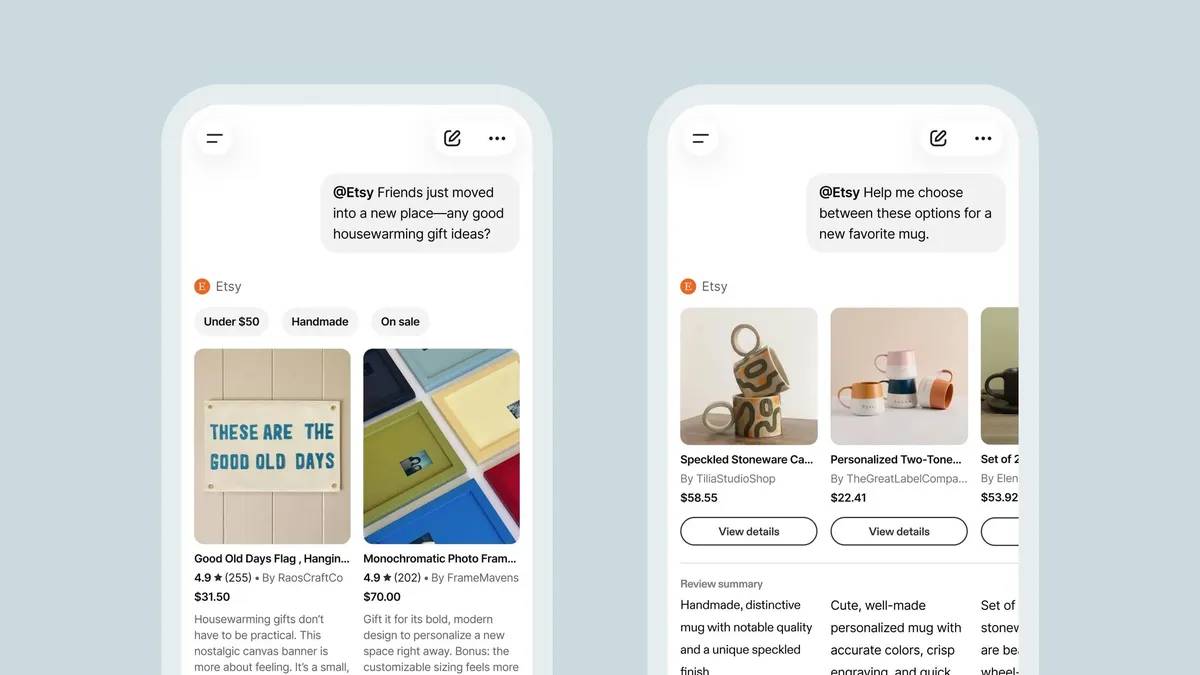
Etsy’s latest integration allows users to browse and discover products directly inside ChatGPT, streamlining the shopping experience from query to product selection.

May 6, 2026
|
Image Source: CNET

Etsy has introduced its shopping app within ChatGPT, marking a renewed attempt to embed e-commerce directly into conversational AI platforms. The move underscores growing competition among digital marketplaces to own AI-driven discovery and transaction flows. The integration is expected to reshape how users search, evaluate, and purchase handmade and niche goods globally.

Etsy’s latest integration allows users to browse and discover products directly inside ChatGPT, streamlining the shopping experience from query to product selection. The rollout follows earlier challenges in achieving seamless AI-based commerce integration but signals renewed confidence in conversational shopping.

The initiative involves collaboration between Etsy and OpenAI, aiming to reduce friction in product discovery and improve personalization through AI prompts. While financial terms were not disclosed, the move aligns with broader industry efforts to embed commerce into AI assistants. The development could influence transaction volumes, seller visibility, and platform competition across global e-commerce ecosystems.

The integration reflects a wider shift in digital commerce, where AI assistants are increasingly becoming discovery engines rather than just informational tools. Platforms like Amazon, Google, and Shopify are also investing heavily in AI-powered shopping experiences, anticipating reduced reliance on traditional search and app-based browsing.

Etsy’s move comes amid intensifying competition in niche e-commerce, where differentiation depends on personalization and user engagement. Previous attempts to merge AI and commerce have faced friction due to accuracy, trust, and conversion challenges. However, advances in large language models and recommendation systems are now improving contextual relevance.

Globally, the convergence of AI and retail is reshaping consumer behavior, with conversational interfaces expected to become a primary gateway for product discovery. This positions AI platforms as intermediaries in the retail value chain, raising strategic implications for digital marketplaces.

Industry analysts view Etsy’s integration as a calculated attempt to reclaim momentum in a rapidly evolving AI commerce landscape. Experts suggest that embedding shopping inside conversational interfaces could significantly reduce customer acquisition costs while increasing engagement time.

However, analysts also caution that AI-driven commerce introduces risks around recommendation bias, product misrepresentation, and fragmented seller competition. Some industry observers argue that platforms like Etsy must balance automation with trust signals to maintain buyer confidence.

While official commentary from Etsy emphasizes improved discovery and user experience, technology strategists highlight that the success of such integrations will depend on conversion efficiency and AI accuracy. Broader market sentiment indicates that this move could pressure competitors to accelerate their own AI commerce strategies across retail ecosystems.

For businesses, this integration signals a shift toward AI-mediated consumer funnels, where visibility is increasingly determined by algorithmic recommendation rather than traditional search ranking. Retailers may need to optimize product data for AI systems rather than just SEO-based discovery.

Investors will closely monitor whether AI-driven commerce improves conversion rates and platform monetization. For consumers, the change could simplify purchasing but also reduce transparency in product selection pathways.

From a policy perspective, regulators may begin scrutinizing how AI systems rank, recommend, and monetize products. This could raise questions about fairness, disclosure, and competition in AI-powered marketplaces, particularly as digital assistants gain influence over purchasing decisions.

The success of Etsy’s ChatGPT integration will depend on user adoption, recommendation accuracy, and conversion performance. Future iterations may expand into more dynamic personalization and real-time purchasing flows. However, challenges around trust, pricing transparency, and platform dependency remain unresolved. Industry watchers expect competing marketplaces to accelerate similar integrations, potentially redefining how digital retail ecosystems operate in an AI-first environment.

Source: CNET
Date: May 2026

  • Featured tools
Figstack AI
Free

Figstack AI is an intelligent assistant for developers that explains code, generates docstrings, converts code between languages, and analyzes time complexity helping you work smarter, not harder.

#
Coding
Learn more
Ai Fiesta
Paid

AI Fiesta is an all-in-one productivity platform that gives users access to multiple leading AI models through a single interface. It includes features like prompt enhancement, image generation, audio transcription and side-by-side model comparison.

#
Copywriting
#
Art Generator
Learn more

Learn more about future of AI

Join 80,000+ Ai enthusiast getting weekly updates on exciting AI tools.
Thank you! Your submission has been received!
Oops! Something went wrong while submitting the form.

Etsy Integrates Shopping App Into ChatGPT

May 6, 2026

Etsy’s latest integration allows users to browse and discover products directly inside ChatGPT, streamlining the shopping experience from query to product selection.

Image Source: CNET

Etsy has introduced its shopping app within ChatGPT, marking a renewed attempt to embed e-commerce directly into conversational AI platforms. The move underscores growing competition among digital marketplaces to own AI-driven discovery and transaction flows. The integration is expected to reshape how users search, evaluate, and purchase handmade and niche goods globally.

Etsy’s latest integration allows users to browse and discover products directly inside ChatGPT, streamlining the shopping experience from query to product selection. The rollout follows earlier challenges in achieving seamless AI-based commerce integration but signals renewed confidence in conversational shopping.

The initiative involves collaboration between Etsy and OpenAI, aiming to reduce friction in product discovery and improve personalization through AI prompts. While financial terms were not disclosed, the move aligns with broader industry efforts to embed commerce into AI assistants. The development could influence transaction volumes, seller visibility, and platform competition across global e-commerce ecosystems.

The integration reflects a wider shift in digital commerce, where AI assistants are increasingly becoming discovery engines rather than just informational tools. Platforms like Amazon, Google, and Shopify are also investing heavily in AI-powered shopping experiences, anticipating reduced reliance on traditional search and app-based browsing.

Etsy’s move comes amid intensifying competition in niche e-commerce, where differentiation depends on personalization and user engagement. Previous attempts to merge AI and commerce have faced friction due to accuracy, trust, and conversion challenges. However, advances in large language models and recommendation systems are now improving contextual relevance.

Globally, the convergence of AI and retail is reshaping consumer behavior, with conversational interfaces expected to become a primary gateway for product discovery. This positions AI platforms as intermediaries in the retail value chain, raising strategic implications for digital marketplaces.

Industry analysts view Etsy’s integration as a calculated attempt to reclaim momentum in a rapidly evolving AI commerce landscape. Experts suggest that embedding shopping inside conversational interfaces could significantly reduce customer acquisition costs while increasing engagement time.

However, analysts also caution that AI-driven commerce introduces risks around recommendation bias, product misrepresentation, and fragmented seller competition. Some industry observers argue that platforms like Etsy must balance automation with trust signals to maintain buyer confidence.

While official commentary from Etsy emphasizes improved discovery and user experience, technology strategists highlight that the success of such integrations will depend on conversion efficiency and AI accuracy. Broader market sentiment indicates that this move could pressure competitors to accelerate their own AI commerce strategies across retail ecosystems.

For businesses, this integration signals a shift toward AI-mediated consumer funnels, where visibility is increasingly determined by algorithmic recommendation rather than traditional search ranking. Retailers may need to optimize product data for AI systems rather than just SEO-based discovery.

Investors will closely monitor whether AI-driven commerce improves conversion rates and platform monetization. For consumers, the change could simplify purchasing but also reduce transparency in product selection pathways.

From a policy perspective, regulators may begin scrutinizing how AI systems rank, recommend, and monetize products. This could raise questions about fairness, disclosure, and competition in AI-powered marketplaces, particularly as digital assistants gain influence over purchasing decisions.

The success of Etsy’s ChatGPT integration will depend on user adoption, recommendation accuracy, and conversion performance. Future iterations may expand into more dynamic personalization and real-time purchasing flows. However, challenges around trust, pricing transparency, and platform dependency remain unresolved. Industry watchers expect competing marketplaces to accelerate similar integrations, potentially redefining how digital retail ecosystems operate in an AI-first environment.

Source: CNET
Date: May 2026

Promote Your Tool

Copy Embed Code

Similar Blogs

May 29, 2026
|

YouTube AI Personalization Redefines Scrolling

The new AI system introduces customized content feeds that respond to user prompts and behavior, dynamically adjusting recommendations beyond traditional algorithmic ranking.
Read more
May 29, 2026
|

Google Chrome AI Download Raises Questions

Reports indicate that certain Chrome installations may have quietly fetched a substantial AI model in the background as part of new browser capabilities tied to on-device intelligence.
Read more
May 29, 2026
|

Apple iOS 27 Transforms Siri AI Assistant

Apple’s iOS 27 is reportedly set to introduce a deeply upgraded version of Siri, integrating more advanced AI capabilities, improved contextual understanding, and tighter system-level functionality.
Read more
May 29, 2026
|

Affordable AI PCs Emerge Globally

The Snapdragon C processors are aimed at budget-friendly laptops optimized for basic productivity and AI-assisted tasks such as content summarization and lightweight generative applications.
Read more
May 29, 2026
|

Water Ready Drones Signal New Robotics Frontier

The HoverAir Aqua introduces waterproofing capabilities that allow stable flight and operation in wet conditions, including takeoff and landing near water surfaces. Early hands-on demonstrations suggest improvements in stability, automated tracking.
Read more
May 29, 2026
|

AI Filmmaking Enters Mainstream at Tribeca

The film, reportedly produced with a budget of just $2,000, leverages generative AI tools for scripting, visuals, and post-production workflows.
Read more