



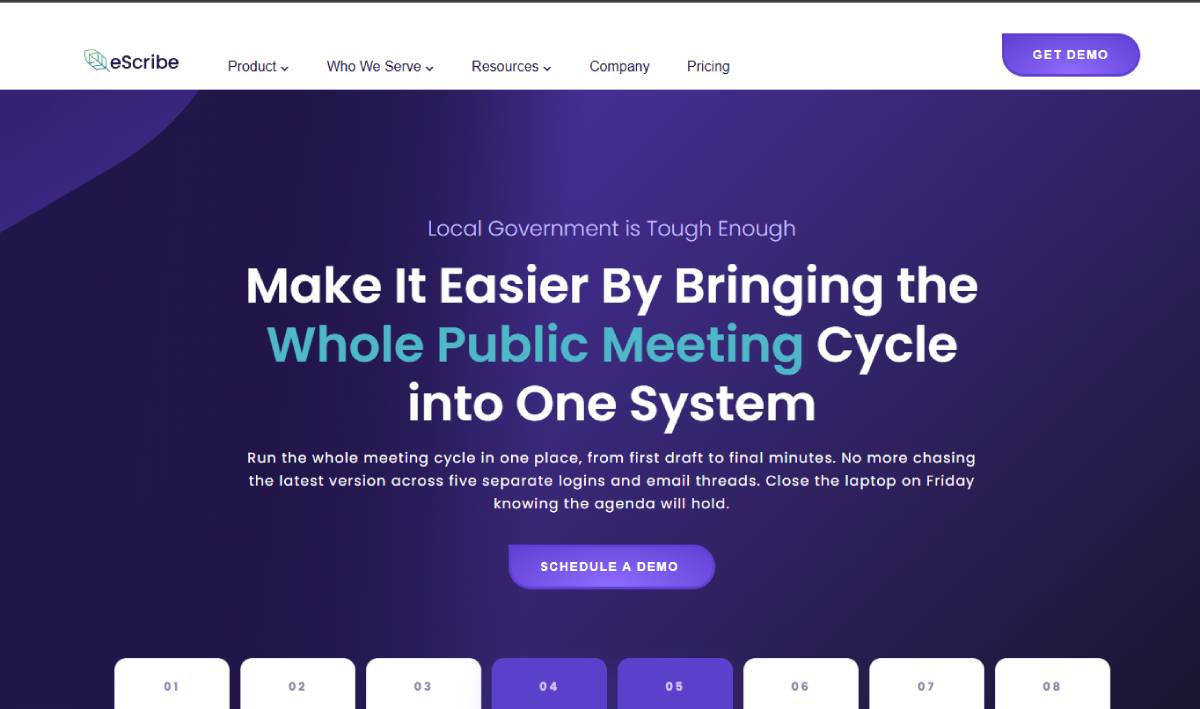
eScribe is advancing digital governance by helping organizations manage meetings, agendas, minutes, documents and official records through a centralized platform. The solution targets public-sector bodies, boards and organizations with formal governance requirements, where transparent documentation, efficient collaboration and reliable recordkeeping are increasingly critical to institutional accountability.
eScribe provides digital tools for managing meeting agendas, minutes, board materials and governance workflows. Its platform is designed to move organizations away from paper-heavy processes and fragmented document management toward structured digital meeting administration.
Core capabilities include agenda creation, meeting management, document distribution, minute preparation and access to governance records. The system supports organizations that need repeatable processes for preparing, conducting and documenting formal meetings.
The platform is particularly relevant to municipalities, school boards, government bodies and other institutions where public meetings and official records form an important part of organizational accountability. Its focus reflects increasing demand for digital governance infrastructure.
The move toward digital governance is part of a wider modernization of public-sector and institutional administration. Governments, boards and regulated organizations manage large volumes of agendas, reports, meeting records and supporting documents, often across multiple stakeholders and jurisdictions.
Traditional paper-based governance processes can create administrative delays and make it harder to distribute documents, track changes and maintain consistent records. Digital meeting-management platforms aim to address these challenges by creating a centralized workflow from agenda preparation through final recordkeeping.
eScribe operates within this broader transition. Its focus on meeting management and governance documentation is particularly relevant for institutions where procedural consistency and public access are important.
The trend also intersects with growing expectations for transparency. Citizens, employees and stakeholders increasingly expect organizations to provide timely access to decisions and official information.
For executives and public-sector leaders, digital governance is therefore not simply an efficiency initiative. It can influence transparency, institutional memory, accountability and the overall quality of administrative decision-making.
eScribe's product positioning emphasizes simplifying governance workflows while providing a structured environment for meeting materials and official records. By centralizing agendas, documents and minutes, the platform can reduce the administrative burden associated with coordinating formal meetings.
The importance of such systems extends beyond meeting convenience. Accurate minutes and accessible supporting documents can provide an institutional record of decisions, responsibilities and organizational actions.
Governance technology also has to accommodate different regulatory and procedural requirements. Public-sector organizations may face specific rules governing meeting notices, public access, record retention and document disclosure.
For technology and administrative leaders, the value of digital governance platforms therefore depends on reliability, security, accessibility and workflow flexibility. Automation can improve efficiency, but organizations must retain appropriate human oversight over official records and decision-making.
The broader market is increasingly moving toward integrated governance environments that connect meeting management with document workflows, collaboration, accessibility and information management.
For organizations, digital meeting management can reduce administrative work, improve document organization and make governance processes more consistent. Boards and executives can access relevant materials through centralized workflows, potentially improving preparation and decision-making.
For public institutions, stronger digital records can support transparency and easier access to official information. Stakeholders may benefit from more organized and accessible governance documentation.
The policy implications are significant. Public bodies must consider records retention, accessibility, privacy, cybersecurity and applicable transparency requirements when digitizing governance processes.
Executives should assess whether a platform supports appropriate permissions, audit trails, document security and accessibility standards. Digital transformation should strengthen accountability rather than simply replace paper with electronic files.
Governance technology is likely to evolve toward greater automation, AI-assisted meeting documentation, searchable institutional records and deeper integration with enterprise collaboration systems. eScribe is positioned within this modernization trend, particularly for organizations with formal meeting and recordkeeping requirements. Decision-makers should monitor security, accessibility, automation accuracy and regulatory alignment. The long-term opportunity is to make governance more efficient while strengthening transparency, accountability and institutional continuity.
Source: eScribe and Crozdesk
Date: August 13, 2026


