



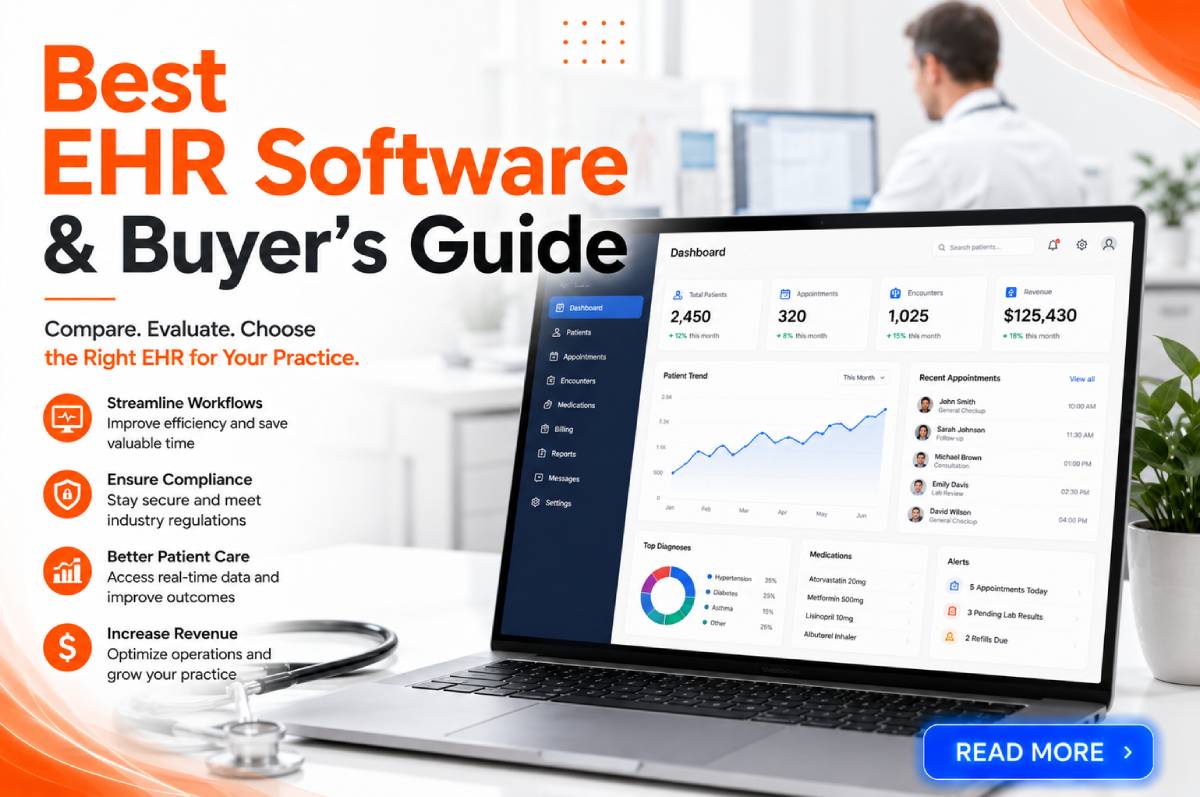
Electronic health record (EHR) software is becoming a critical component of modern healthcare infrastructure, helping providers manage patient information, clinical workflows, documentation and administrative operations digitally. As healthcare organizations pursue greater efficiency and connected care, selecting the right EHR platform has become an increasingly important strategic and operational decision.
The EHR software market encompasses platforms designed to centralize electronic patient records while supporting clinical and administrative workflows. Key capabilities commonly include patient management, appointment scheduling, medical documentation, billing, reporting and interoperability.
Healthcare providers increasingly evaluate software based on usability, scalability, security, integration capabilities and overall cost. The buyer's guide approach gives organizations a framework for comparing solutions according to their operational requirements rather than relying solely on feature volume.
For executives, the decision increasingly extends beyond digitization to improving workflow efficiency, data accessibility and long-term technology resilience. The development aligns with a broader transformation across global healthcare, where digital systems are becoming fundamental to how medical organizations operate. EHR platforms have evolved from electronic recordkeeping tools into broader systems supporting clinical coordination, patient engagement, analytics and administrative management.
This transition is particularly important as healthcare organizations handle growing volumes of patient data while facing pressure to improve service quality and operational efficiency. Interoperability has also become increasingly significant as providers seek to connect information across departments, facilities and other healthcare technologies.
At the same time, cybersecurity, privacy and regulatory compliance remain central considerations. Healthcare data is highly sensitive, making secure infrastructure and controlled access essential. Against this backdrop, choosing an EHR platform has become a strategic technology decision with implications for productivity, patient experience and organizational governance.
Industry analysis generally places usability, interoperability, security and scalability among the most important considerations when evaluating EHR technology. Healthcare technology leaders also emphasize that successful implementation depends on how effectively software fits existing clinical workflows.
From an executive perspective, an EHR platform should not be assessed simply as a software purchase. Decision-makers must consider implementation complexity, employee adoption, integration requirements, vendor support and the platform's ability to accommodate future organizational growth.
Analysts also point to the importance of balancing advanced functionality with practical usability. A system with extensive capabilities can create operational friction if clinicians and administrative teams find it difficult to navigate. Consequently, buyer evaluations increasingly focus on the complete technology ecosystem, including integration, data management, security and user experience.
For healthcare organizations, EHR selection can directly influence operational efficiency, workforce productivity and the accessibility of patient information. Providers may benefit from streamlined documentation, centralized records and improved coordination between clinical and administrative teams.
Investors and healthcare executives should also consider the long-term economics of implementation, including licensing, customization, training, maintenance and integration costs. Consumers ultimately stand to benefit when digital systems contribute to smoother care coordination and more accessible health information.
From a policy perspective, continued digitization increases the importance of interoperability, cybersecurity, privacy safeguards and responsible management of sensitive health data. Organizations will need to align technology investments with evolving regulatory expectations while maintaining strong governance over patient information.
The EHR market is likely to continue moving toward more connected, intelligent and workflow-oriented healthcare platforms. Decision-makers should watch developments in interoperability, automation, analytics, cybersecurity and AI-enabled clinical support. The strongest solutions will be those that combine technological sophistication with usability, compliance and measurable operational value. For healthcare leaders, EHR selection is increasingly an enterprise strategy decision rather than a routine software purchase.
Source: Crozdesk
Date: August 11, 2026


