
Duke Expands Workplace AI Support Strategy

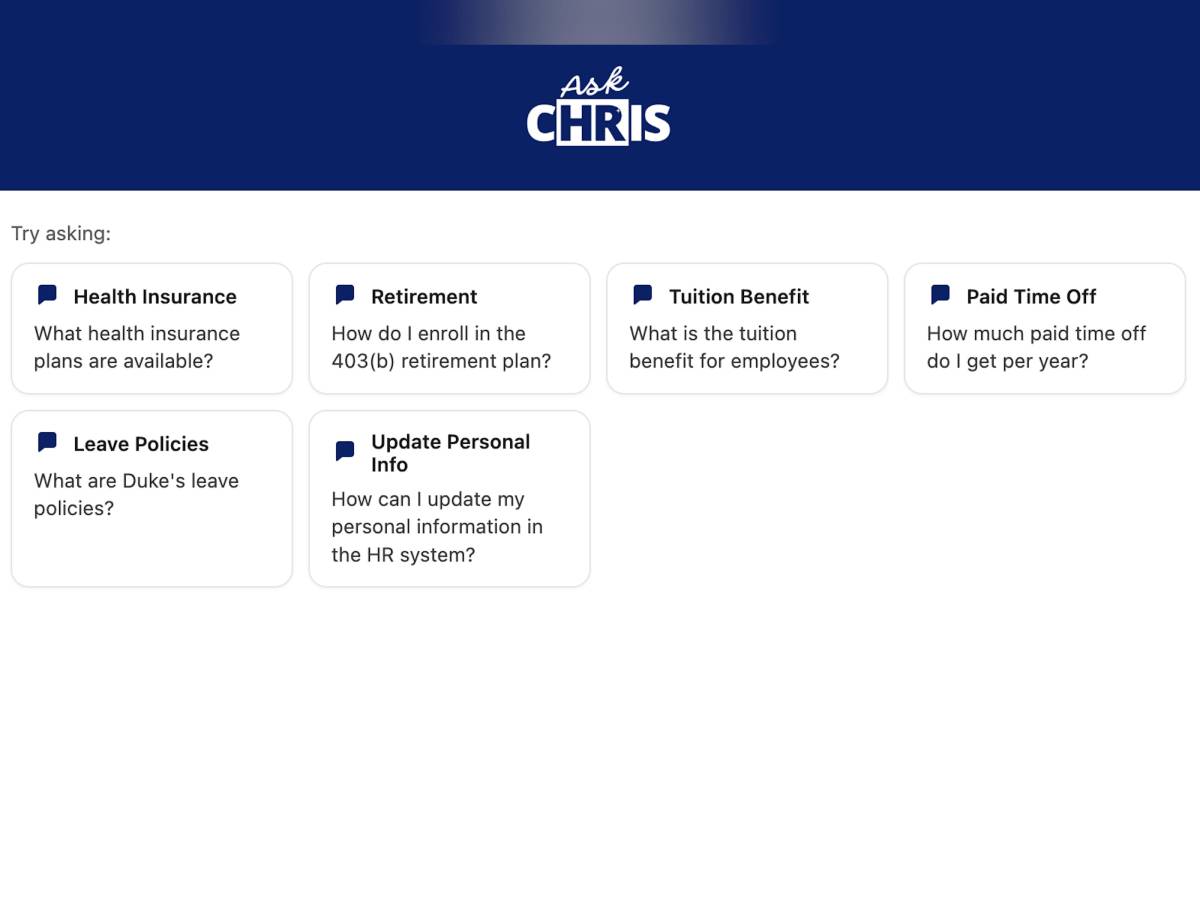
Duke University's Human Resources department has introduced “Ask CHRIS,” an AI-powered chatbot developed to assist employees with inquiries related to benefits, policies, payroll, leave programs.

June 8, 2026
|
Image Source:  Duke Chronicle

A significant workplace AI initiative has emerged in the higher education sector as Duke University launches an artificial intelligence-powered human resources chatbot designed to answer employee questions and streamline access to workplace information. The move reflects a growing trend among organizations leveraging AI to enhance operational efficiency, reduce administrative workloads, and improve employee experiences in an increasingly digital workplace environment.

Duke University's Human Resources department has introduced “Ask CHRIS,” an AI-powered chatbot developed to assist employees with inquiries related to benefits, policies, payroll, leave programs, workplace resources, and other HR-related matters.

The chatbot is being rolled out as part of a pilot initiative aimed at improving access to information while reducing response times for routine employee questions. University officials expect the tool to help manage high volumes of inquiries that traditionally require human intervention.

Employees can access the platform through authenticated university systems, allowing the chatbot to provide more personalized and context-specific responses. The initiative represents a broader effort by Duke to integrate artificial intelligence into administrative operations while maintaining oversight and governance standards.

The deployment of AI-powered workplace assistants reflects a wider transformation occurring across both public and private sector organizations. Enterprises worldwide are increasingly investing in generative AI solutions to automate repetitive tasks, improve productivity, and enhance user experiences.

Human resources has emerged as one of the most promising areas for AI adoption due to the large volume of employee inquiries and administrative processes involved. From benefits administration and onboarding to policy guidance and workforce analytics, organizations are exploring how AI can augment HR teams while allowing professionals to focus on more strategic responsibilities.

Universities have also become important testing grounds for AI innovation. Institutions are balancing demands for operational efficiency with the need to support large and diverse employee populations. Duke’s chatbot initiative follows a series of AI-related deployments across academia, where institutions are experimenting with AI-powered learning tools, research support systems, and administrative assistants.

The development aligns with broader workforce digitization trends that accelerated following the pandemic and continue to reshape how organizations interact with employees. University officials have positioned the chatbot as a practical tool designed to simplify access to information rather than replace human expertise. Leaders involved in the initiative emphasize that employees often spend significant time navigating complex policy documents and HR websites to find answers to routine questions.

Technology and HR specialists view these deployments as part of a larger shift toward intelligent workplace platforms. Analysts argue that AI assistants can significantly reduce administrative friction, improve employee satisfaction, and lower operational costs when implemented responsibly.

However, experts also caution that workplace AI systems require careful governance. Accuracy, transparency, privacy protections, and human oversight remain critical considerations, particularly when AI is used to provide guidance on employment policies, benefits, compensation, or legal compliance issues.

Industry observers note that successful implementations are typically those that position AI as a support mechanism rather than a replacement for human judgment. Organizations that strike this balance are expected to gain meaningful productivity advantages while maintaining employee trust and confidence.

For executives and business leaders, Duke’s initiative highlights the growing role of AI in transforming internal business operations. Human resources departments are increasingly becoming early adopters of AI because of the measurable efficiency gains that automation can deliver.

The project offers a blueprint for organizations evaluating workplace AI strategies. Companies may look to similar systems to improve employee self-service capabilities, reduce support costs, and accelerate response times across administrative functions.

From a policy perspective, the initiative reinforces the importance of establishing governance frameworks for enterprise AI deployments. Organizations must ensure that AI-generated information remains accurate, secure, and aligned with employment regulations. As adoption expands, regulators and business leaders alike will continue examining how AI can improve workplace efficiency while safeguarding employee rights and organizational accountability.

The success of Duke’s pilot program will likely influence future investments in AI-driven workplace services across higher education and beyond. Decision-makers will closely monitor employee adoption rates, satisfaction levels, and operational outcomes to assess the technology’s long-term value.

As organizations continue integrating generative AI into everyday workflows, workplace assistants are expected to become increasingly common. The institutions that successfully combine innovation with responsible governance may emerge as leaders in the next phase of enterprise AI transformation.

Source: Duke Chronicle
Date:
June 8, 2026

  • Featured tools
Hostinger Website Builder
Paid

Hostinger Website Builder is a drag-and-drop website creator bundled with hosting and AI-powered tools, designed for businesses, blogs and small shops with minimal technical effort.It makes launching a site fast and affordable, with templates, responsive design and built-in hosting all in one.

#
Productivity
#
Startup Tools
#
Ecommerce
Learn more
Hostinger Horizons
Freemium

Hostinger Horizons is an AI-powered platform that allows users to build and deploy custom web applications without writing code. It packs hosting, domain management and backend integration into a unified tool for rapid app creation.

#
Startup Tools
#
Coding
#
Project Management
Learn more

Learn more about future of AI

Join 80,000+ Ai enthusiast getting weekly updates on exciting AI tools.
Thank you! Your submission has been received!
Oops! Something went wrong while submitting the form.

Duke Expands Workplace AI Support Strategy

June 8, 2026

Duke University's Human Resources department has introduced “Ask CHRIS,” an AI-powered chatbot developed to assist employees with inquiries related to benefits, policies, payroll, leave programs.

Image Source:  Duke Chronicle

A significant workplace AI initiative has emerged in the higher education sector as Duke University launches an artificial intelligence-powered human resources chatbot designed to answer employee questions and streamline access to workplace information. The move reflects a growing trend among organizations leveraging AI to enhance operational efficiency, reduce administrative workloads, and improve employee experiences in an increasingly digital workplace environment.

Duke University's Human Resources department has introduced “Ask CHRIS,” an AI-powered chatbot developed to assist employees with inquiries related to benefits, policies, payroll, leave programs, workplace resources, and other HR-related matters.

The chatbot is being rolled out as part of a pilot initiative aimed at improving access to information while reducing response times for routine employee questions. University officials expect the tool to help manage high volumes of inquiries that traditionally require human intervention.

Employees can access the platform through authenticated university systems, allowing the chatbot to provide more personalized and context-specific responses. The initiative represents a broader effort by Duke to integrate artificial intelligence into administrative operations while maintaining oversight and governance standards.

The deployment of AI-powered workplace assistants reflects a wider transformation occurring across both public and private sector organizations. Enterprises worldwide are increasingly investing in generative AI solutions to automate repetitive tasks, improve productivity, and enhance user experiences.

Human resources has emerged as one of the most promising areas for AI adoption due to the large volume of employee inquiries and administrative processes involved. From benefits administration and onboarding to policy guidance and workforce analytics, organizations are exploring how AI can augment HR teams while allowing professionals to focus on more strategic responsibilities.

Universities have also become important testing grounds for AI innovation. Institutions are balancing demands for operational efficiency with the need to support large and diverse employee populations. Duke’s chatbot initiative follows a series of AI-related deployments across academia, where institutions are experimenting with AI-powered learning tools, research support systems, and administrative assistants.

The development aligns with broader workforce digitization trends that accelerated following the pandemic and continue to reshape how organizations interact with employees. University officials have positioned the chatbot as a practical tool designed to simplify access to information rather than replace human expertise. Leaders involved in the initiative emphasize that employees often spend significant time navigating complex policy documents and HR websites to find answers to routine questions.

Technology and HR specialists view these deployments as part of a larger shift toward intelligent workplace platforms. Analysts argue that AI assistants can significantly reduce administrative friction, improve employee satisfaction, and lower operational costs when implemented responsibly.

However, experts also caution that workplace AI systems require careful governance. Accuracy, transparency, privacy protections, and human oversight remain critical considerations, particularly when AI is used to provide guidance on employment policies, benefits, compensation, or legal compliance issues.

Industry observers note that successful implementations are typically those that position AI as a support mechanism rather than a replacement for human judgment. Organizations that strike this balance are expected to gain meaningful productivity advantages while maintaining employee trust and confidence.

For executives and business leaders, Duke’s initiative highlights the growing role of AI in transforming internal business operations. Human resources departments are increasingly becoming early adopters of AI because of the measurable efficiency gains that automation can deliver.

The project offers a blueprint for organizations evaluating workplace AI strategies. Companies may look to similar systems to improve employee self-service capabilities, reduce support costs, and accelerate response times across administrative functions.

From a policy perspective, the initiative reinforces the importance of establishing governance frameworks for enterprise AI deployments. Organizations must ensure that AI-generated information remains accurate, secure, and aligned with employment regulations. As adoption expands, regulators and business leaders alike will continue examining how AI can improve workplace efficiency while safeguarding employee rights and organizational accountability.

The success of Duke’s pilot program will likely influence future investments in AI-driven workplace services across higher education and beyond. Decision-makers will closely monitor employee adoption rates, satisfaction levels, and operational outcomes to assess the technology’s long-term value.

As organizations continue integrating generative AI into everyday workflows, workplace assistants are expected to become increasingly common. The institutions that successfully combine innovation with responsible governance may emerge as leaders in the next phase of enterprise AI transformation.

Source: Duke Chronicle
Date:
June 8, 2026

Promote Your Tool

Copy Embed Code

Similar Blogs

June 19, 2026
|

Apple iPhone Camera Controls Expand AI

The report outlines how users can modify or disable AI-assisted camera functions on Apple iPhone devices, particularly features that influence image processing and computational enhancements.
Read more
June 19, 2026
|

Samsung Expands Galaxy AI Controls Push

The guide details how users can adjust or disable AI-driven features on Samsung Galaxy smartphones, including tools integrated into Samsung Galaxy smartphones.
Read more
June 19, 2026
|

Google Expands Smart Home Ecosystem

The latest compilation of Google voice commands focuses on how users can interact with Google Assistant and connected smart home systems. Commands span entertainment, home automation, productivity, navigation.
Read more
June 19, 2026
|

AI Dating Apps Face User Backlash

Survey data indicates that while adoption of AI-based dating assistants and companion tools is increasing, user sentiment is becoming increasingly polarized.
Read more
June 19, 2026
|

Apple Signals Price Hikes Amid Cost Pressures

Apple CEO Tim Cook indicated that escalating costs tied to components such as memory, advanced processors, and logistics are becoming structurally embedded across the company’s manufacturing pipeline.
Read more
June 19, 2026
|

Adobe Embeds AI Assistants Across Tools

Adobe is positioning these assistants as task-oriented agents capable of handling repetitive editing workflows such as object removal.
Read more