
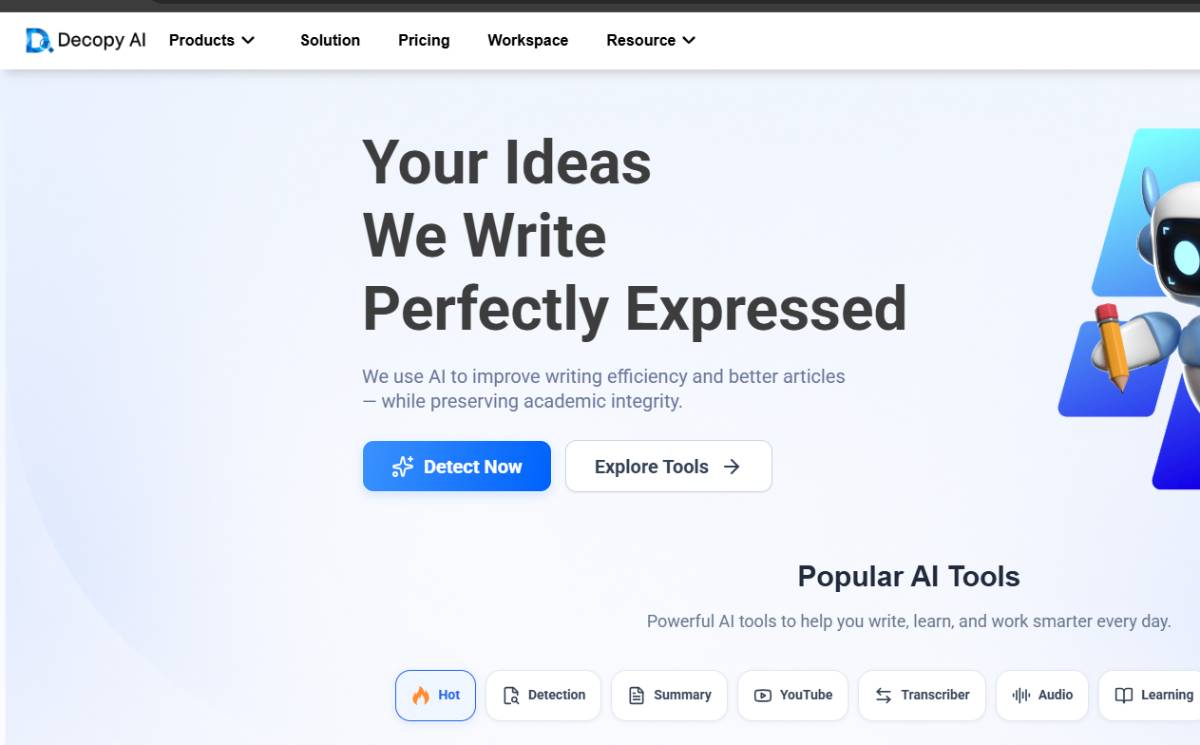
Decopy AI Boosts Business Productivity

Decopy AI is an AI-powered writing and content generation platform designed to assist users in creating, refining, and optimizing written material for professional and commercial use.

July 29, 2026
|

Decopy AI reflects the rapid evolution of generative artificial intelligence in digital content creation and workplace productivity. As organizations increasingly adopt AI-powered writing and automation tools, the platform highlights a broader transformation in enterprise software, marketing technology, and knowledge management with significant implications for businesses, creators, and policymakers worldwide.

Decopy AI is an AI-powered writing and content generation platform designed to assist users in creating, refining, and optimizing written material for professional and commercial use. By leveraging generative AI, the platform aims to improve efficiency, reduce manual workloads, and accelerate content production.

Its emergence comes as enterprises expand investments in AI-driven productivity tools across marketing, customer engagement, education, and business communications. Organizations increasingly seek intelligent software capable of generating high-quality content while supporting workflow automation, collaboration, and faster decision-making in competitive digital environments.

The global market for generative AI has expanded rapidly following breakthroughs in large language models, natural language processing, and cloud computing. Businesses across industries are integrating AI into daily operations to improve efficiency, enhance creativity, and streamline repetitive tasks.

Content generation has become one of the fastest-growing enterprise AI applications, supporting functions such as marketing, technical documentation, customer service, internal communications, and knowledge management. AI-powered writing assistants are increasingly embedded within enterprise software ecosystems, enabling organizations to scale content production while maintaining consistency.

At the same time, governments and regulators are developing policies addressing AI governance, transparency, copyright, data privacy, and responsible deployment. These discussions reflect the need to balance technological innovation with ethical safeguards and public trust as AI adoption accelerates globally.

Industry analysts consider generative AI one of the most transformative technologies affecting enterprise productivity. Experts suggest AI writing assistants can significantly reduce time spent on drafting, editing, summarizing, and content planning, allowing professionals to focus on higher-value strategic work.

Technology consultants emphasize that successful AI implementation requires strong governance frameworks, human oversight, and rigorous data security practices. Organizations are encouraged to establish clear policies governing AI-generated content, intellectual property, and quality assurance.

Although no official corporate statements accompany the platform's listing, market observers broadly agree that AI-assisted content creation will become a standard feature across enterprise software. Businesses that integrate these technologies responsibly are expected to improve operational efficiency while maintaining regulatory compliance and brand integrity.

For businesses, Decopy AI illustrates how generative AI can accelerate content production, improve employee productivity, and reduce operational costs across marketing, communications, and customer engagement functions. Companies adopting AI-assisted workflows may strengthen competitiveness while scaling digital operations more efficiently.

Investors continue monitoring enterprise AI and software-as-a-service (SaaS) markets, where productivity applications remain key growth drivers. For policymakers, expanding AI adoption reinforces the importance of balanced regulations addressing transparency, accountability, copyright, cybersecurity, and workforce adaptation to ensure innovation develops alongside responsible governance.

Enterprise demand for AI-powered content platforms is expected to increase as organizations integrate generative AI into broader digital transformation strategies. Decision-makers should monitor advancements in multimodal AI, regulatory developments, and enterprise governance standards. As intelligent writing assistants become more capable and widely adopted, platforms like Decopy AI are positioned to contribute to the next generation of AI-enabled productivity and business automation.

Source: AlternativeTo
Date:July 23, 2026

  • Featured tools
Copy Ai
Free

Copy AI is one of the most popular AI writing tools designed to help professionals create high-quality content quickly. Whether you are a product manager drafting feature descriptions or a marketer creating ad copy, Copy AI can save hours of work while maintaining creativity and tone.

#
Copywriting
Learn more
Symphony Ayasdi AI
Free

SymphonyAI Sensa is an AI-powered surveillance and financial crime detection platform that surfaces hidden risk behavior through explainable, AI-driven analytics.

#
Finance
Learn more

Learn more about future of AI

Join 80,000+ Ai enthusiast getting weekly updates on exciting AI tools.
Thank you! Your submission has been received!
Oops! Something went wrong while submitting the form.

Decopy AI Boosts Business Productivity

July 29, 2026

Decopy AI is an AI-powered writing and content generation platform designed to assist users in creating, refining, and optimizing written material for professional and commercial use.

Decopy AI reflects the rapid evolution of generative artificial intelligence in digital content creation and workplace productivity. As organizations increasingly adopt AI-powered writing and automation tools, the platform highlights a broader transformation in enterprise software, marketing technology, and knowledge management with significant implications for businesses, creators, and policymakers worldwide.

Decopy AI is an AI-powered writing and content generation platform designed to assist users in creating, refining, and optimizing written material for professional and commercial use. By leveraging generative AI, the platform aims to improve efficiency, reduce manual workloads, and accelerate content production.

Its emergence comes as enterprises expand investments in AI-driven productivity tools across marketing, customer engagement, education, and business communications. Organizations increasingly seek intelligent software capable of generating high-quality content while supporting workflow automation, collaboration, and faster decision-making in competitive digital environments.

The global market for generative AI has expanded rapidly following breakthroughs in large language models, natural language processing, and cloud computing. Businesses across industries are integrating AI into daily operations to improve efficiency, enhance creativity, and streamline repetitive tasks.

Content generation has become one of the fastest-growing enterprise AI applications, supporting functions such as marketing, technical documentation, customer service, internal communications, and knowledge management. AI-powered writing assistants are increasingly embedded within enterprise software ecosystems, enabling organizations to scale content production while maintaining consistency.

At the same time, governments and regulators are developing policies addressing AI governance, transparency, copyright, data privacy, and responsible deployment. These discussions reflect the need to balance technological innovation with ethical safeguards and public trust as AI adoption accelerates globally.

Industry analysts consider generative AI one of the most transformative technologies affecting enterprise productivity. Experts suggest AI writing assistants can significantly reduce time spent on drafting, editing, summarizing, and content planning, allowing professionals to focus on higher-value strategic work.

Technology consultants emphasize that successful AI implementation requires strong governance frameworks, human oversight, and rigorous data security practices. Organizations are encouraged to establish clear policies governing AI-generated content, intellectual property, and quality assurance.

Although no official corporate statements accompany the platform's listing, market observers broadly agree that AI-assisted content creation will become a standard feature across enterprise software. Businesses that integrate these technologies responsibly are expected to improve operational efficiency while maintaining regulatory compliance and brand integrity.

For businesses, Decopy AI illustrates how generative AI can accelerate content production, improve employee productivity, and reduce operational costs across marketing, communications, and customer engagement functions. Companies adopting AI-assisted workflows may strengthen competitiveness while scaling digital operations more efficiently.

Investors continue monitoring enterprise AI and software-as-a-service (SaaS) markets, where productivity applications remain key growth drivers. For policymakers, expanding AI adoption reinforces the importance of balanced regulations addressing transparency, accountability, copyright, cybersecurity, and workforce adaptation to ensure innovation develops alongside responsible governance.

Enterprise demand for AI-powered content platforms is expected to increase as organizations integrate generative AI into broader digital transformation strategies. Decision-makers should monitor advancements in multimodal AI, regulatory developments, and enterprise governance standards. As intelligent writing assistants become more capable and widely adopted, platforms like Decopy AI are positioned to contribute to the next generation of AI-enabled productivity and business automation.

Source: AlternativeTo
Date:July 23, 2026

Promote Your Tool

Copy Embed Code

Similar Blogs

August 14, 2026
|

Benefitfocus Expands Digital Benefits Administration

Benefitfocus provides cloud-based technology covering benefits enrollment, administration, communications, billing, payments and data exchange.
Read more
August 14, 2026
|

Travel Agent Revenue Models Evolve Digitally

Travel agencies can earn commissions when customers book hotels, cruises, tours, vacation packages and other travel products through them. Suppliers may pay agents for generating bookings, making commissions a traditional component of agency revenue.
Read more
August 14, 2026
|

Sofon Advances Guided Selling CPQ Automation

Sofon's platform combines guided selling, product configuration, pricing, quotation and sales-management capabilities. Guided questionnaires help sales teams identify customer requirements and translate them into suitable product configurations.
Read more
August 14, 2026
|

WellRyde Advances Medical Transportation Management

WellRyde provides technology for managing non-emergency medical transportation operations, including trip scheduling, dispatch coordination, transportation-provider management and reporting.
Read more
August 14, 2026
|

Review WAVE Advances Digital Patient Engagement

Review WAVE provides healthcare practices with tools for online appointment scheduling, two-way texting, automated appointment reminders, digital forms, web chat, marketing campaigns and online review generation.
Read more
August 14, 2026
|

Edgenuity Expands Digital Virtual Education

Edgenuity provides digital curriculum and learning solutions covering core academic subjects, electives, Advanced Placement and career-oriented education.
Read more