
Cybersecurity Comparison Highlights Enterprise Protection Shifts

The comparison brings together three security-focused offerings with different market positions and capabilities. U.S.T.A. appears within Crozdesk’s Cyber & Data Security category.

August 10, 2026
|

A comparative assessment of U.S.T.A., cWatch and Mimecast highlights the growing complexity of enterprise cybersecurity as organizations balance email protection, web security, threat detection and broader risk management. The comparison is relevant for technology leaders evaluating security platforms amid escalating cyber threats, expanding digital infrastructure and increasingly demanding compliance requirements.

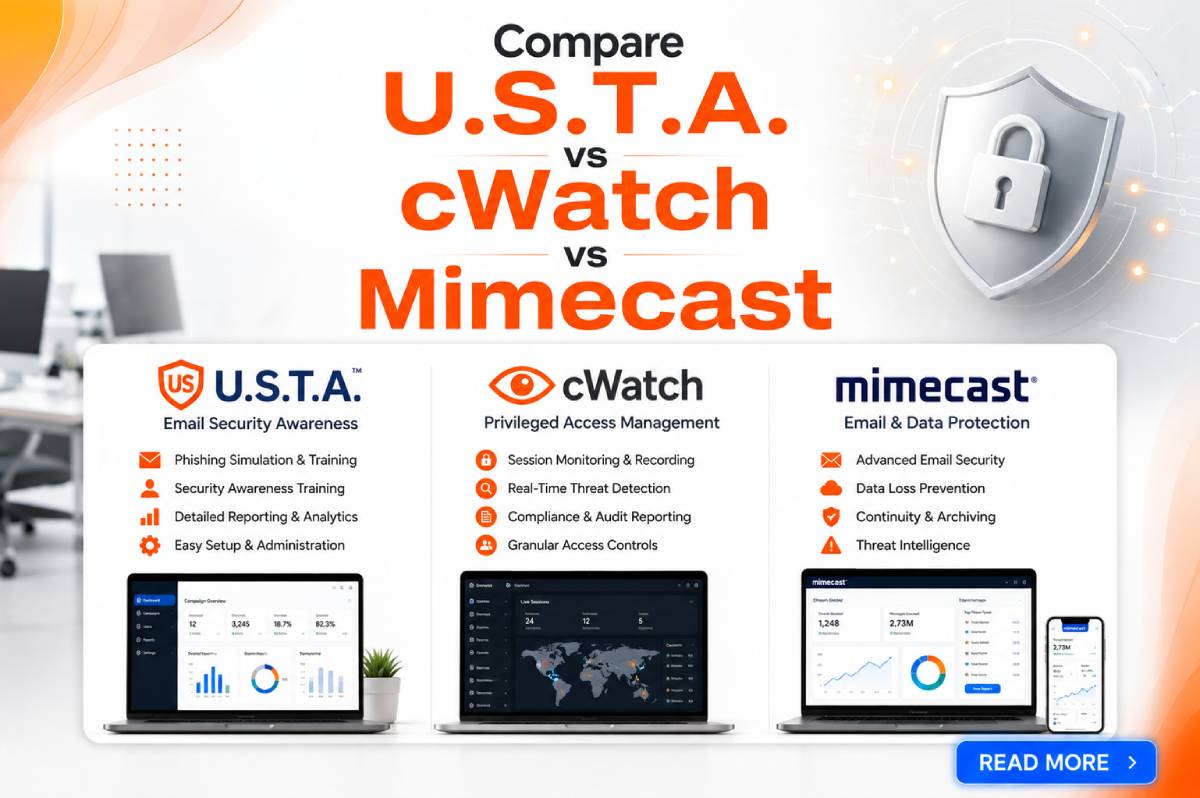
The comparison brings together three security-focused offerings with different market positions and capabilities. U.S.T.A. appears within Crozdesk’s Cyber & Data Security category, while cWatch and Mimecast are established names associated with cybersecurity and digital protection.

The evaluation provides organizations with a framework for examining security functionality, deployment requirements, usability and suitability for different operational environments. For enterprise decision-makers, the distinction is important because cybersecurity platforms increasingly need to protect multiple attack surfaces rather than address isolated threats.

The comparison also reflects a broader shift toward evaluating security technology based on operational fit, scalability and the ability to integrate with existing IT environments. The development aligns with a broader trend across global markets where cybersecurity has moved from an IT-level concern to a board-level business priority. Organizations now face phishing, ransomware, credential theft, data exposure, malicious websites and increasingly sophisticated social-engineering campaigns.

As cloud adoption and remote work have expanded enterprise attack surfaces, security teams are under pressure to consolidate protection while maintaining visibility across users, devices, applications and communications. This has increased demand for platforms capable of addressing multiple security requirements within increasingly complex technology environments.

Email security remains particularly important because business communication continues to be a major pathway for phishing and malware campaigns. At the same time, web and cloud security have become critical as employees access corporate resources from distributed locations.

For executives, comparisons such as this can therefore support broader technology procurement decisions by highlighting differences in functionality, implementation and operational alignment.

Cybersecurity analysts generally emphasize that organizations should avoid selecting security software solely on feature counts or market visibility. The effectiveness of a platform depends heavily on how well it fits an organization's infrastructure, security policies, workforce profile and risk exposure.

Mimecast's established position in email and human-risk protection illustrates the importance of defending communication channels, while cWatch represents a security approach associated with website and online protection. U.S.T.A., meanwhile, is listed by Crozdesk within the Cyber & Data Security category, giving buyers another option to evaluate within the wider security software landscape.

For security leaders, the more important question is whether a platform can deliver measurable improvements in threat detection, incident response, visibility and resilience. Analysts also increasingly stress integration, automation and ease of administration as critical factors as security teams manage growing tool portfolios.

For global executives, cybersecurity platform selection increasingly influences operational resilience, regulatory readiness and the potential financial impact of security incidents. Businesses should evaluate solutions against their specific threat profile rather than assuming that the most recognizable platform will automatically provide the best fit.

Investors may also view cybersecurity spending as a strategic resilience investment rather than discretionary IT expenditure. Consumers and employees benefit indirectly when organizations strengthen protection against phishing, malware and data compromise.

From a policy perspective, increasingly stringent privacy, cybersecurity and critical-infrastructure requirements are encouraging organizations to strengthen security controls and document risk-management practices. Decision-makers should therefore consider compliance capabilities alongside technical performance, scalability and total cost of ownership.

The cybersecurity market is likely to continue moving toward integrated, intelligence-driven protection as organizations seek to reduce fragmented security operations. Decision-makers should monitor threat-detection capabilities, integration, automation, deployment complexity and measurable security outcomes when comparing U.S.T.A., cWatch, Mimecast and competing platforms. The strategic priority will be building security architectures that remain resilient as threats, regulations and digital infrastructure continue to evolve.

Source: Crozdesk
Date: August 10, 2026

  • Featured tools
Copy Ai
Free

Copy AI is one of the most popular AI writing tools designed to help professionals create high-quality content quickly. Whether you are a product manager drafting feature descriptions or a marketer creating ad copy, Copy AI can save hours of work while maintaining creativity and tone.

#
Copywriting
Learn more
Surfer AI
Free

Surfer AI is an AI-powered content creation assistant built into the Surfer SEO platform, designed to generate SEO-optimized articles from prompts, leveraging data from search results to inform tone, structure, and relevance.

#
SEO
Learn more

Learn more about future of AI

Join 80,000+ Ai enthusiast getting weekly updates on exciting AI tools.
Thank you! Your submission has been received!
Oops! Something went wrong while submitting the form.

Cybersecurity Comparison Highlights Enterprise Protection Shifts

August 10, 2026

The comparison brings together three security-focused offerings with different market positions and capabilities. U.S.T.A. appears within Crozdesk’s Cyber & Data Security category.

A comparative assessment of U.S.T.A., cWatch and Mimecast highlights the growing complexity of enterprise cybersecurity as organizations balance email protection, web security, threat detection and broader risk management. The comparison is relevant for technology leaders evaluating security platforms amid escalating cyber threats, expanding digital infrastructure and increasingly demanding compliance requirements.

The comparison brings together three security-focused offerings with different market positions and capabilities. U.S.T.A. appears within Crozdesk’s Cyber & Data Security category, while cWatch and Mimecast are established names associated with cybersecurity and digital protection.

The evaluation provides organizations with a framework for examining security functionality, deployment requirements, usability and suitability for different operational environments. For enterprise decision-makers, the distinction is important because cybersecurity platforms increasingly need to protect multiple attack surfaces rather than address isolated threats.

The comparison also reflects a broader shift toward evaluating security technology based on operational fit, scalability and the ability to integrate with existing IT environments. The development aligns with a broader trend across global markets where cybersecurity has moved from an IT-level concern to a board-level business priority. Organizations now face phishing, ransomware, credential theft, data exposure, malicious websites and increasingly sophisticated social-engineering campaigns.

As cloud adoption and remote work have expanded enterprise attack surfaces, security teams are under pressure to consolidate protection while maintaining visibility across users, devices, applications and communications. This has increased demand for platforms capable of addressing multiple security requirements within increasingly complex technology environments.

Email security remains particularly important because business communication continues to be a major pathway for phishing and malware campaigns. At the same time, web and cloud security have become critical as employees access corporate resources from distributed locations.

For executives, comparisons such as this can therefore support broader technology procurement decisions by highlighting differences in functionality, implementation and operational alignment.

Cybersecurity analysts generally emphasize that organizations should avoid selecting security software solely on feature counts or market visibility. The effectiveness of a platform depends heavily on how well it fits an organization's infrastructure, security policies, workforce profile and risk exposure.

Mimecast's established position in email and human-risk protection illustrates the importance of defending communication channels, while cWatch represents a security approach associated with website and online protection. U.S.T.A., meanwhile, is listed by Crozdesk within the Cyber & Data Security category, giving buyers another option to evaluate within the wider security software landscape.

For security leaders, the more important question is whether a platform can deliver measurable improvements in threat detection, incident response, visibility and resilience. Analysts also increasingly stress integration, automation and ease of administration as critical factors as security teams manage growing tool portfolios.

For global executives, cybersecurity platform selection increasingly influences operational resilience, regulatory readiness and the potential financial impact of security incidents. Businesses should evaluate solutions against their specific threat profile rather than assuming that the most recognizable platform will automatically provide the best fit.

Investors may also view cybersecurity spending as a strategic resilience investment rather than discretionary IT expenditure. Consumers and employees benefit indirectly when organizations strengthen protection against phishing, malware and data compromise.

From a policy perspective, increasingly stringent privacy, cybersecurity and critical-infrastructure requirements are encouraging organizations to strengthen security controls and document risk-management practices. Decision-makers should therefore consider compliance capabilities alongside technical performance, scalability and total cost of ownership.

The cybersecurity market is likely to continue moving toward integrated, intelligence-driven protection as organizations seek to reduce fragmented security operations. Decision-makers should monitor threat-detection capabilities, integration, automation, deployment complexity and measurable security outcomes when comparing U.S.T.A., cWatch, Mimecast and competing platforms. The strategic priority will be building security architectures that remain resilient as threats, regulations and digital infrastructure continue to evolve.

Source: Crozdesk
Date: August 10, 2026

Promote Your Tool

Copy Embed Code

Similar Blogs

August 10, 2026
|

Vendor Platforms Accelerate Enterprise Risk Automation

The three platforms represent different approaches to enterprise process management. VendorInsight focuses on vendor governance, compliance oversight, due diligence and third-party risk management, areas that are becoming increasingly important for regulated organizations.
Read more
August 10, 2026
|

BuildBook Advances Construction Project Management

BuildBook combines construction CRM, estimating, proposals and project-management capabilities within one platform. Its tools include custom estimates, branded proposals, price books, project budgets.
Read more
August 10, 2026
|

Readymode Strengthens AI Outbound Sales Operations

Readymode combines predictive dialing, inbound and outbound calling, CRM functionality, reporting and analytics within a unified platform.
Read more
August 10, 2026
|

Employee Engagement Software Reshapes Workforce Strategy

Employee engagement platforms bring multiple workforce-experience functions into centralized digital environments.
Read more
August 10, 2026
|

NinjaProxy Expands Enterprise Proxy Infrastructure

NinjaProxy provides proxy services designed to support different connectivity requirements, including shared, private, residential and mobile proxy options.
Read more
August 10, 2026
|

Volgistics Advances Volunteer Workforce Management

Volgistics provides organizations with tools designed to manage the operational lifecycle of volunteers. Core capabilities include volunteer scheduling, time tracking, recruitment, communication, reporting and centralized record management.
Read more