



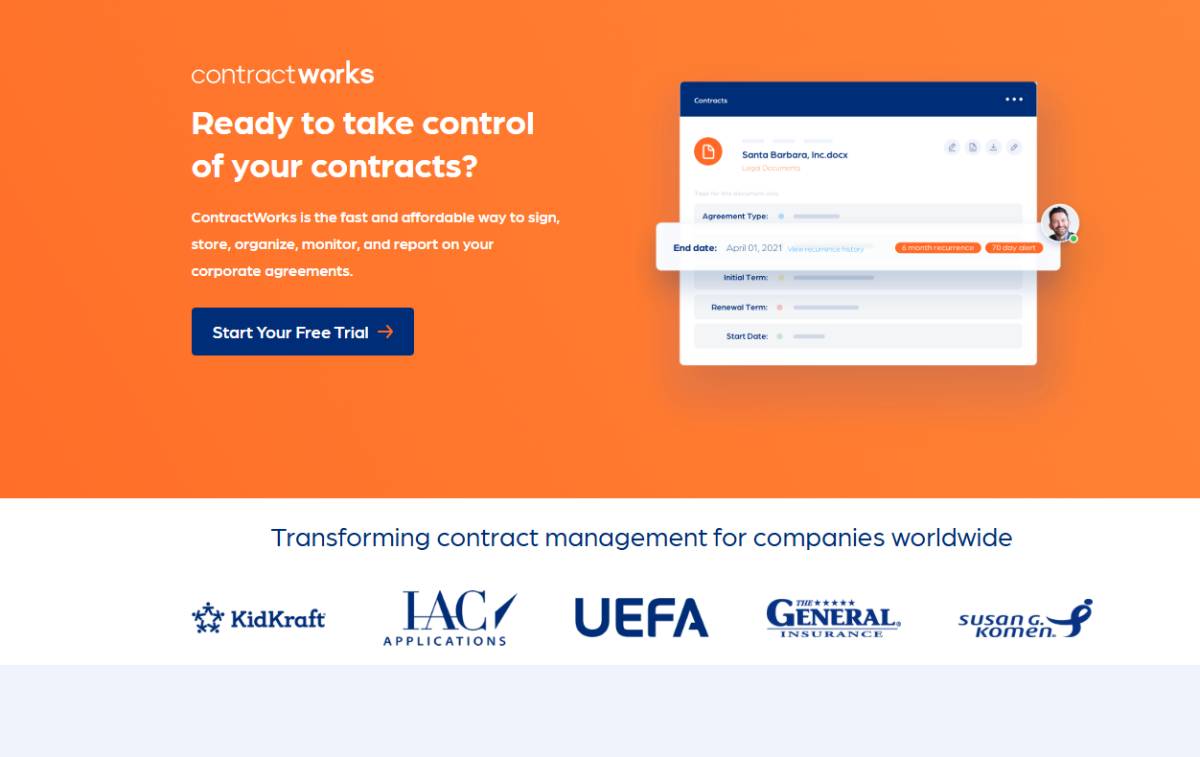
ContractWorks is advancing digital contract management by helping organizations centralize, organize and monitor agreements through a structured cloud-based environment. The platform addresses growing pressure on businesses to improve contract visibility, reduce administrative work and manage critical obligations more effectively as commercial relationships become increasingly complex and distributed.
ContractWorks provides organizations with tools for storing, organizing and managing contracts in a centralized digital repository. The platform is designed to make agreements easier to locate while providing greater visibility into important contract information.
Key capabilities include contract storage, document organization, automated reminders, reporting and electronic signature functionality. These features can help organizations monitor renewal dates, expiration timelines and other contractual obligations.
The platform is relevant to legal, procurement, finance and operations teams that manage significant volumes of agreements. Its approach reflects a broader transition away from spreadsheets, shared folders and paper-based contract administration toward dedicated contract lifecycle management.
For executives, centralized contract information can provide greater visibility into commercial commitments and potential operational risks. Contracts underpin almost every major business relationship, from supplier agreements and employment arrangements to customer deals, partnerships and regulatory commitments. Yet many organizations continue to manage contracts through fragmented systems, making it difficult to identify important deadlines and obligations.
The expansion of contract lifecycle management technology reflects a broader effort to digitize legal and administrative operations. Centralized repositories can help organizations reduce document-search time, standardize workflows and improve access to critical agreements.
ContractWorks operates within this transformation by focusing on accessible contract management for businesses that need greater control over their agreements without necessarily deploying highly complex enterprise legal systems.
The economic implications can be significant. Missed renewals, unfavorable terms, compliance failures or overlooked obligations can create unnecessary costs and operational exposure.
For executives, contract management is therefore increasingly viewed as a strategic business function. Better visibility into agreements can support procurement decisions, revenue management, risk reduction and stronger relationships with customers and suppliers.
ContractWorks' positioning reflects an increasing emphasis on making contract information accessible to teams beyond traditional legal departments. Centralized contract repositories can allow authorized users to locate agreements and monitor key dates without repeatedly depending on manual searches.
Legal and procurement professionals generally emphasize that effective contract management requires more than document storage. Organizations also need consistent approval processes, appropriate access controls, accurate metadata and reliable monitoring of obligations.
Automated reminders can be particularly valuable for contracts involving renewals, expirations or recurring commitments. By surfacing important dates in advance, businesses can reduce the likelihood of unintentionally allowing agreements to renew or expire.
The broader legal-technology market is moving toward AI-assisted contract analysis, automated extraction and workflow intelligence. These capabilities could eventually help organizations identify unusual clauses, assess risks and summarize contractual obligations more efficiently.
For executives, the strategic priority is to turn contracts from static documents into accessible sources of commercial and risk intelligence. For businesses, digital contract management can improve document organization, reduce administrative effort and provide greater visibility into contractual obligations. Legal and procurement teams can potentially spend less time searching for agreements and more time managing commercial priorities.
For investors and executives, stronger contract controls can reduce risks associated with missed deadlines, unfavorable renewals and incomplete documentation. Better visibility may also support more informed supplier and customer negotiations.
The policy dimension includes data privacy, information security, electronic records and retention requirements. Organizations must ensure that sensitive agreements are protected through appropriate access controls and governance procedures.
Executives should assess security, reporting, integrations, automation, scalability and user permissions when implementing contract-management technology across legal and business functions.
Contract management is expected to become increasingly intelligent as AI-assisted analysis, automated obligation tracking and workflow integration reshape legal operations. ContractWorks is positioned within this broader transition from document storage toward more proactive contract management. Decision-makers should monitor AI capabilities, security, integration and analytics as they evaluate future platforms. The strategic opportunity is to make contractual information easier to access, manage and use while reducing legal and commercial risk.
Source: ContractWorks and Crozdesk
Date: August 13, 2026


