
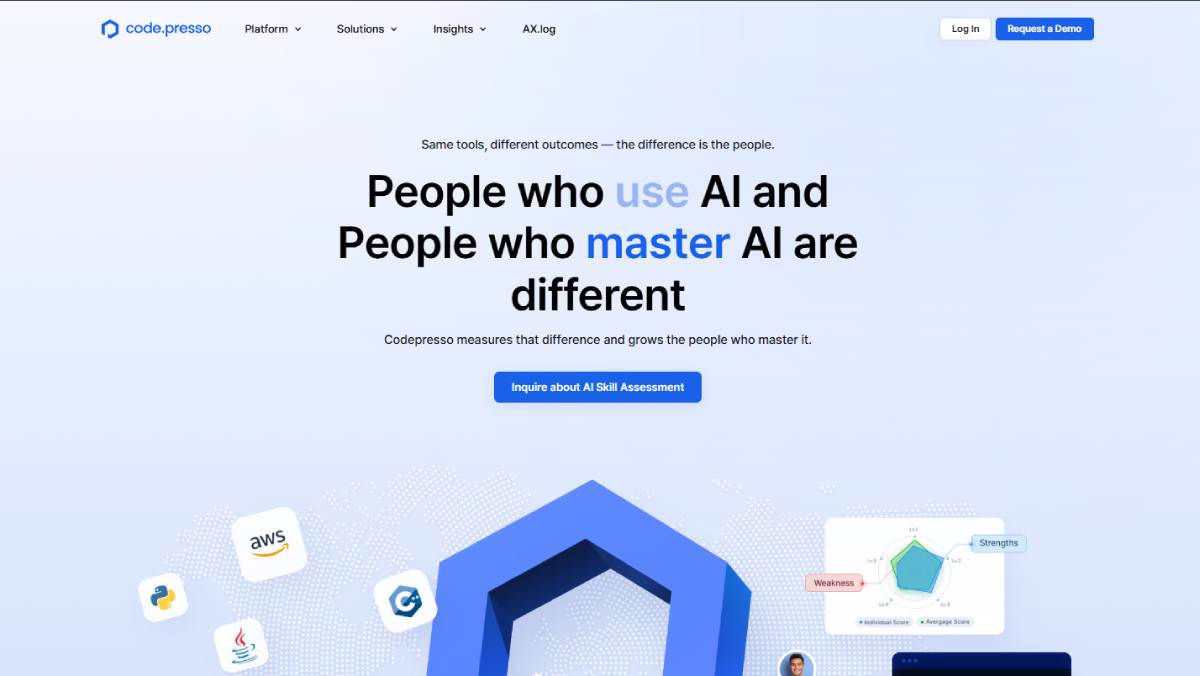
Codepresso Champions Skills Based Hiring

Codepresso advocates replacing conventional CV-based recruitment with skills-focused assessments that better measure candidates’ real-world capabilities.

July 3, 2026
|

A significant shift is reshaping global recruitment as technology firms increasingly prioritize verified skills over traditional résumés. Codepresso is championing a skills-first hiring model that leverages technical assessments and AI-driven evaluation, reflecting broader changes in how employers identify talent amid growing digital workforce shortages.

Codepresso advocates replacing conventional CV-based recruitment with skills-focused assessments that better measure candidates’ real-world capabilities. The company's approach emphasizes practical coding tests, competency validation, and AI-supported evaluation tools to help employers identify qualified talent regardless of academic background or previous job titles.

The initiative responds to growing employer demand for faster, more objective recruitment processes while addressing persistent shortages of skilled technology professionals. As businesses accelerate digital transformation and AI adoption, organizations are increasingly seeking recruitment models that reduce hiring bias, improve workforce quality, and shorten recruitment timelines across competitive labor markets.

The movement toward skills-based hiring reflects one of the most significant transformations in global human capital management. Across industries, employers are finding that traditional academic credentials and work histories often provide limited insight into a candidate's actual capabilities, particularly in rapidly evolving technology fields.

Artificial intelligence, cloud computing, cybersecurity, software engineering, and data analytics require continuously updated technical skills that may not be reflected in formal qualifications. Consequently, organizations are increasingly adopting competency-based recruitment, online assessments, and digital credentialing systems to identify talent more effectively.

Governments and educational institutions are also encouraging lifelong learning and workforce reskilling as automation reshapes employment patterns. Europe has placed particular emphasis on closing digital skills gaps through workforce development initiatives designed to improve competitiveness while supporting innovation across both public and private sectors.

Human resources analysts increasingly argue that skills-based hiring can improve workforce diversity, productivity, and long-term employee performance by expanding access to qualified candidates from non-traditional educational and professional backgrounds. Competency-focused recruitment enables employers to identify practical abilities rather than relying solely on conventional career pathways.

Technology leaders also emphasize that AI-powered recruitment tools should complement not replace human decision-making. While automated assessments can improve efficiency and consistency, organizations must ensure transparency, fairness, and compliance with emerging regulations governing artificial intelligence in employment.

Industry experts further note that successful implementation requires continuous validation of assessment methods alongside investment in employee development and reskilling. Companies adopting skills-first recruitment strategies are increasingly positioning themselves to respond more effectively to evolving labor market demands while building agile, future-ready workforces capable of adapting to technological change.

For employers, the shift toward skills-based hiring offers opportunities to widen talent pools, reduce recruitment costs, and improve workforce quality through objective competency evaluation. Businesses investing in AI-driven hiring technologies may gain competitive advantages in attracting highly skilled professionals amid ongoing talent shortages.

Investors are also monitoring HR technology companies developing assessment platforms, digital credentialing solutions, and AI-enabled recruitment systems. Policymakers, meanwhile, may continue supporting workforce reskilling, vocational education, and digital certification initiatives to better align labor markets with future industry requirements while encouraging fair and inclusive hiring practices across the European economy.

Skills-based hiring is expected to become increasingly mainstream as artificial intelligence, automation, and digital transformation reshape workforce requirements. Organizations that successfully integrate competency assessments with ethical AI recruitment practices may strengthen both hiring efficiency and long-term talent retention. As employers increasingly prioritize demonstrated capability over traditional credentials, workforce development strategies will continue evolving to support a rapidly changing global economy.

Source: Silicon Luxembourg
Date: July 3, 2026

  • Featured tools
Neuron AI
Free

Neuron AI is an AI-driven content optimization platform that helps creators produce SEO-friendly content by combining semantic SEO, competitor analysis, and AI-assisted writing workflows.

#
SEO
Learn more
Ai Fiesta
Paid

AI Fiesta is an all-in-one productivity platform that gives users access to multiple leading AI models through a single interface. It includes features like prompt enhancement, image generation, audio transcription and side-by-side model comparison.

#
Copywriting
#
Art Generator
Learn more

Learn more about future of AI

Join 80,000+ Ai enthusiast getting weekly updates on exciting AI tools.
Thank you! Your submission has been received!
Oops! Something went wrong while submitting the form.

Codepresso Champions Skills Based Hiring

July 3, 2026

Codepresso advocates replacing conventional CV-based recruitment with skills-focused assessments that better measure candidates’ real-world capabilities.

A significant shift is reshaping global recruitment as technology firms increasingly prioritize verified skills over traditional résumés. Codepresso is championing a skills-first hiring model that leverages technical assessments and AI-driven evaluation, reflecting broader changes in how employers identify talent amid growing digital workforce shortages.

Codepresso advocates replacing conventional CV-based recruitment with skills-focused assessments that better measure candidates’ real-world capabilities. The company's approach emphasizes practical coding tests, competency validation, and AI-supported evaluation tools to help employers identify qualified talent regardless of academic background or previous job titles.

The initiative responds to growing employer demand for faster, more objective recruitment processes while addressing persistent shortages of skilled technology professionals. As businesses accelerate digital transformation and AI adoption, organizations are increasingly seeking recruitment models that reduce hiring bias, improve workforce quality, and shorten recruitment timelines across competitive labor markets.

The movement toward skills-based hiring reflects one of the most significant transformations in global human capital management. Across industries, employers are finding that traditional academic credentials and work histories often provide limited insight into a candidate's actual capabilities, particularly in rapidly evolving technology fields.

Artificial intelligence, cloud computing, cybersecurity, software engineering, and data analytics require continuously updated technical skills that may not be reflected in formal qualifications. Consequently, organizations are increasingly adopting competency-based recruitment, online assessments, and digital credentialing systems to identify talent more effectively.

Governments and educational institutions are also encouraging lifelong learning and workforce reskilling as automation reshapes employment patterns. Europe has placed particular emphasis on closing digital skills gaps through workforce development initiatives designed to improve competitiveness while supporting innovation across both public and private sectors.

Human resources analysts increasingly argue that skills-based hiring can improve workforce diversity, productivity, and long-term employee performance by expanding access to qualified candidates from non-traditional educational and professional backgrounds. Competency-focused recruitment enables employers to identify practical abilities rather than relying solely on conventional career pathways.

Technology leaders also emphasize that AI-powered recruitment tools should complement not replace human decision-making. While automated assessments can improve efficiency and consistency, organizations must ensure transparency, fairness, and compliance with emerging regulations governing artificial intelligence in employment.

Industry experts further note that successful implementation requires continuous validation of assessment methods alongside investment in employee development and reskilling. Companies adopting skills-first recruitment strategies are increasingly positioning themselves to respond more effectively to evolving labor market demands while building agile, future-ready workforces capable of adapting to technological change.

For employers, the shift toward skills-based hiring offers opportunities to widen talent pools, reduce recruitment costs, and improve workforce quality through objective competency evaluation. Businesses investing in AI-driven hiring technologies may gain competitive advantages in attracting highly skilled professionals amid ongoing talent shortages.

Investors are also monitoring HR technology companies developing assessment platforms, digital credentialing solutions, and AI-enabled recruitment systems. Policymakers, meanwhile, may continue supporting workforce reskilling, vocational education, and digital certification initiatives to better align labor markets with future industry requirements while encouraging fair and inclusive hiring practices across the European economy.

Skills-based hiring is expected to become increasingly mainstream as artificial intelligence, automation, and digital transformation reshape workforce requirements. Organizations that successfully integrate competency assessments with ethical AI recruitment practices may strengthen both hiring efficiency and long-term talent retention. As employers increasingly prioritize demonstrated capability over traditional credentials, workforce development strategies will continue evolving to support a rapidly changing global economy.

Source: Silicon Luxembourg
Date: July 3, 2026

Promote Your Tool

Copy Embed Code

Similar Blogs

July 3, 2026
|

Europe’s Scale Imperative Gains Focus

The NordicTech briefing outlines a clear acceleration in capital concentration and cross-border scaling efforts across European tech ecosystems.
Read more
July 3, 2026
|

OnBuy Expands Nordics Marketplace Model

OnBuy’s Nordic launch introduces a marketplace structure that connects buyers and sellers without holding inventory or directly completing transactions.
Read more
July 3, 2026
|

Denmark Deploys €200M Scale Up Fund

The €200 million allocation is designed to support late-stage startups transitioning into scale-up phases, where companies often face funding gaps and international acquisition pressure.
Read more
July 3, 2026
|

Hyundai Backed Finnish Battery Scale-Up

The €12.5 million investment round brings together strategic industrial players and venture investors focused on accelerating the commercialization of advanced battery storage systems.
Read more
July 3, 2026
|

Norwegian Robotics Startup Raises €12M

Six Robotics secured €12 million in a seed round aimed at scaling its “swarm intelligence” platform, which functions as the central decision-making layer for coordinated drone operations.
Read more
July 3, 2026
|

Luxembourg Startup Advances Defense Digital Twins

The startup is building advanced digital twin solutions capable of creating real-time virtual representations of battlefield environments.
Read more