



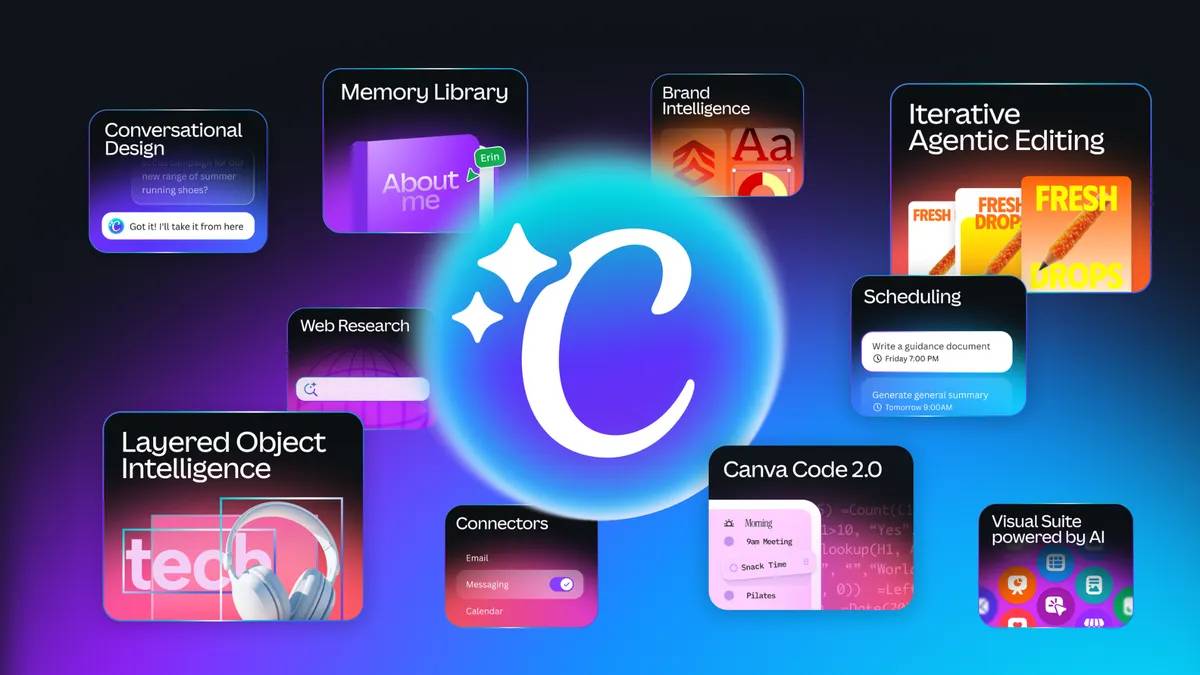
A major development is unfolding in enterprise software as Canva pushes deeper into workplace AI, positioning itself beyond design tools into full productivity orchestration. The company’s latest AI integrations aim to connect workflows, automate tasks, and embed itself into corporate operations, signaling intensified competition in the enterprise AI productivity stack.
Canva has introduced expanded AI-driven workplace features aimed at transforming its platform from a design tool into an integrated productivity ecosystem. The updates include AI connectors, scheduling assistance, and workflow automation designed to interact with external enterprise applications.
The rollout is part of Canva’s broader “Create” initiative, targeting business users who increasingly rely on generative AI for content production and operational efficiency.
The company is positioning itself against traditional productivity suites by embedding AI as a core interface layer rather than a supplemental feature, effectively expanding its footprint into enterprise workflow management and collaboration infrastructure.
The enterprise software market is undergoing rapid consolidation around AI-first productivity ecosystems. Tools that once served narrow functions design, document creation, scheduling are being re-engineered into unified platforms powered by generative AI.
Canva initially built its reputation as a simplified design platform, but the rise of AI-native tools has forced it to expand into adjacent workflow categories. This reflects a broader shift where software companies are competing to become “system-of-work” platforms rather than single-purpose applications.
The trend aligns with enterprise demand for reduced tool fragmentation, where organizations prefer fewer, AI-integrated platforms capable of handling multiple operational layers.
It also intensifies competition with established productivity ecosystems from Microsoft, Google, and emerging AI-native startups building workflow automation layers. Industry analysts suggest Canva’s strategy reflects a broader pivot in SaaS markets toward AI consolidation, where platform companies attempt to own both content creation and workflow execution layers.
Experts note that embedding AI scheduling, connectors, and automation tools positions Canva closer to enterprise operating systems than traditional design software. Corporate adoption, however, will depend on integration depth with existing enterprise stacks such as CRM, cloud storage, and communication tools.
While Canva has not explicitly framed itself as an enterprise workflow competitor, market observers argue its product evolution increasingly overlaps with productivity suites traditionally dominated by large cloud providers. Analysts also highlight that user trust, data governance, and enterprise-grade security will be critical in determining adoption at scale.
For enterprises, Canva’s expansion signals increasing consolidation in workplace software, where fewer platforms may handle broader operational workloads. This could reduce software fragmentation but increase vendor dependency.
For investors, the move highlights a growing AI SaaS convergence trend, where valuation premiums shift toward platforms with embedded automation ecosystems. For competitors, especially legacy productivity providers, the pressure to accelerate AI integration is intensifying.
From a policy perspective, deeper AI integration into workplace tools raises questions around data handling, cross-application permissions, and enterprise AI governance standards. Regulators may increasingly focus on how AI productivity platforms manage sensitive business data flows.
The success of Canva’s workplace AI push will depend on enterprise adoption beyond creative teams into core business operations. If integrations prove seamless, Canva could evolve into a broader productivity platform competing directly with established enterprise suites. However, integration complexity and enterprise security requirements may slow scaling. The next phase will determine whether Canva becomes a workflow layer or remains primarily a creative intelligence platform.
Source: CNET
Date: April 20, 2026


