



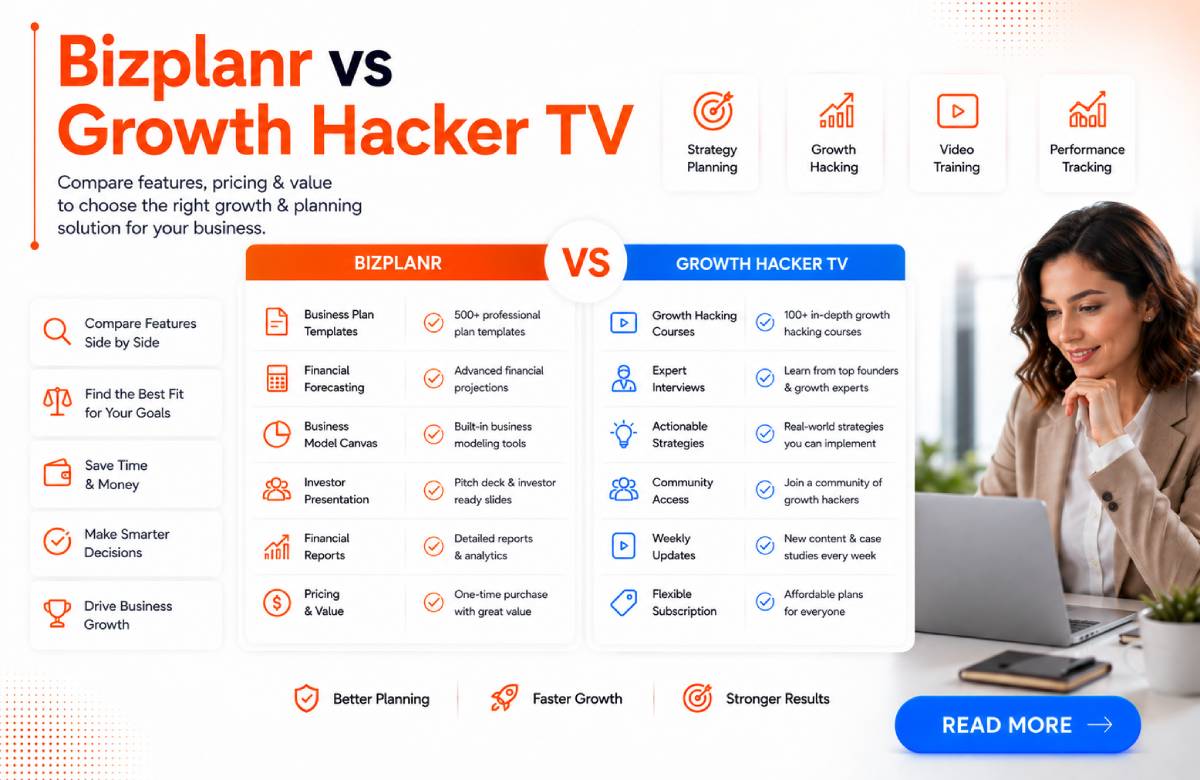
The comparison between Bizplanr and Growth Hacker TV highlights two distinct approaches to supporting entrepreneurs and growing businesses. While Bizplanr focuses on structured business planning and strategy development, Growth Hacker TV emphasizes growth marketing education, experimentation and acquisition tactics, reflecting changing priorities among startups and modern business leaders.
Bizplanr is positioned as a business-planning platform designed to help entrepreneurs develop structured business plans, financial projections, market analysis and strategic documents. Its approach centers on organizing the information required to launch or grow a business.
Growth Hacker TV takes a different route, focusing on educational content and growth-marketing knowledge. Its resources are aimed at entrepreneurs and marketers seeking practical approaches to customer acquisition, experimentation, conversion and scalable growth.
The comparison therefore represents more than a software-versus-software assessment. It illustrates how entrepreneurs increasingly combine formal planning tools with specialized growth education to address different stages of business development.
The comparison comes amid a changing global startup environment in which founders face pressure to validate ideas quickly, manage limited capital and demonstrate measurable growth. Business planning remains important for establishing financial assumptions and strategic direction, but modern startups also increasingly emphasize experimentation and rapid customer feedback.
Bizplanr's planning-oriented model addresses the need for structured strategy, financial forecasting and business documentation. Growth Hacker TV represents the education-driven side of entrepreneurship, where founders and marketers seek practical knowledge about acquisition and growth methodologies.
These approaches reflect two complementary dimensions of business development. Planning can help define where a company intends to go, while growth experimentation can help determine which strategies actually generate customer demand.
For executives and investors, the distinction is significant. A strong business concept still requires disciplined financial planning, but sustainable growth increasingly depends on the ability to test assumptions, understand customers and adapt quickly as markets change.
From an entrepreneurial perspective, Bizplanr and Growth Hacker TV address different decision-making requirements. Business-planning platforms can help founders translate ideas into structured strategies, financial models and operational assumptions. Growth-focused educational resources can provide frameworks for testing those assumptions in the market.
Industry experience suggests that neither planning nor growth experimentation operates effectively in isolation. Excessive planning can delay market validation, while aggressive growth tactics without sound financial and operational foundations can create inefficient spending.
For business leaders, the most useful approach is often sequential and iterative: establish a credible business model, define measurable objectives, test market assumptions and continuously update the strategy based on evidence.
The comparison also highlights a broader shift in entrepreneurship education. Founders increasingly expect digital platforms to provide practical, immediately applicable guidance rather than relying exclusively on traditional consulting or classroom-based business education.
For startups, the comparison demonstrates the importance of combining strategic planning with execution-focused growth capabilities. Bizplanr can support the planning and financial side of entrepreneurship, while Growth Hacker TV can contribute educational resources focused on growth marketing.
For investors, these capabilities can influence how founders evaluate markets, manage resources and communicate business assumptions. Strong planning may improve capital allocation, while effective growth experimentation can help validate demand.
From a policy perspective, easier access to digital entrepreneurship resources can support small-business formation and entrepreneurial participation. However, founders still need reliable financial assumptions, responsible marketing practices and appropriate data-protection controls when implementing growth strategies.
Entrepreneurship platforms are likely to become increasingly integrated with AI, financial modeling, market research and growth analytics. Bizplanr and Growth Hacker TV represent complementary approaches to the broader startup-support ecosystem. Decision-makers should focus on measurable outcomes: validated demand, disciplined spending, customer acquisition efficiency and sustainable revenue. The strongest entrepreneurial strategies will increasingly combine structured planning with rapid, evidence-based market experimentation.
Source: Crozdesk
Date: August 13, 2026


