
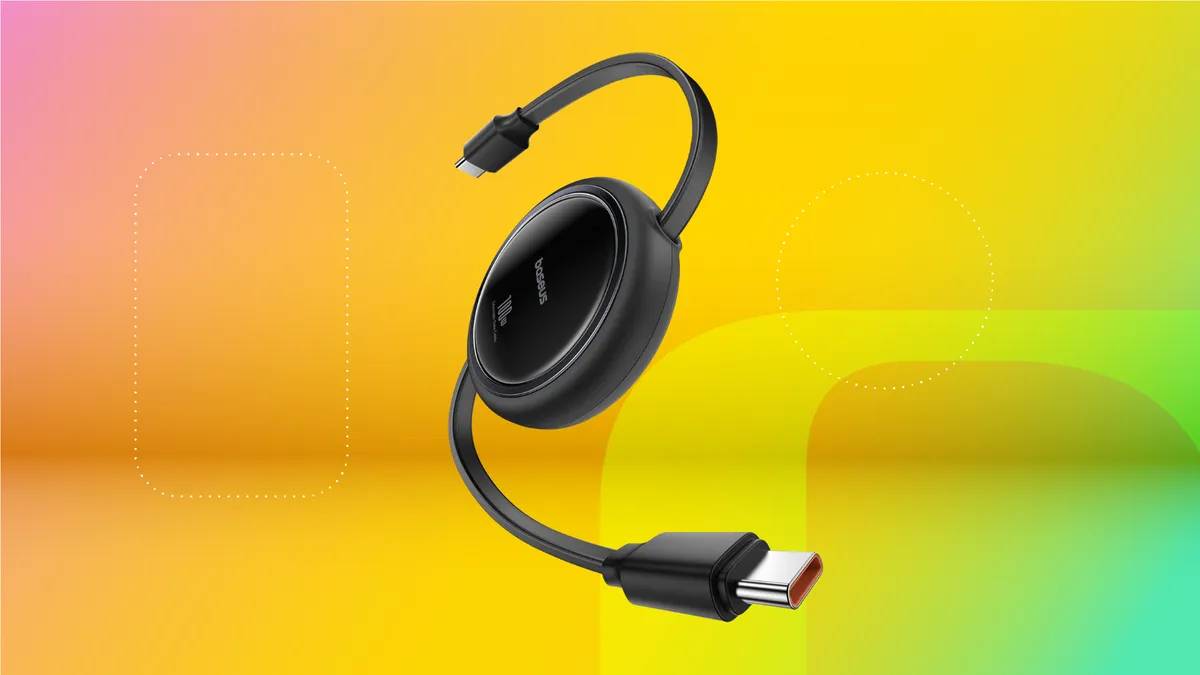
Baseus Retractable USB-C Cable Drops $7

The Baseus retractable USB-C cable, designed for travel convenience and multi-device compatibility, has been discounted significantly to $7 using a limited-time promotional code.

May 18, 2026
|
Image Source: CNET Deals Report

A new consumer electronics pricing move has drawn attention in global accessory markets as a portable charging solution from Baseus drops to an ultra-low $7 price point through a promotional code. The deal, highlighted by tech outlet CNET, underscores intensifying competition in the mobile accessories segment and rising price sensitivity among digital consumers.

The Baseus retractable USB-C cable, designed for travel convenience and multi-device compatibility, has been discounted significantly to $7 using a limited-time promotional code. The offer was reported by CNET as part of a broader wave of aggressive pricing in mobile accessories.

The product is positioned for users requiring compact charging solutions for smartphones, tablets, and laptops. Retail dynamics indicate that such steep discounts are increasingly used by accessory brands to capture attention in saturated online marketplaces. The move reflects heightened competition among low-cost electronics manufacturers seeking scale in global e-commerce channels.

The discounting strategy emerges within a highly competitive global accessories market where USB-C adoption has become the universal standard across consumer electronics. As device manufacturers consolidate toward unified charging protocols, third-party brands like Baseus are expanding aggressively into mass-market ecosystems.

Over the past few years, travel-friendly accessories particularly retractable cables, fast chargers, and multi-port hubs have seen exponential growth due to remote work, mobile-first lifestyles, and cross-device usage patterns. The USB-C ecosystem, now dominant across smartphones, laptops, and tablets, has created a commoditized hardware segment where differentiation is driven largely by price, portability, and branding.

Historically, accessory markets mirror broader hardware cycles: once standards stabilize, pricing pressure intensifies, and competition shifts toward volume-driven sales strategies across Amazon, Alibaba-linked ecosystems, and direct-to-consumer platforms.

Industry analysts suggest that ultra-low pricing strategies, such as the $7 promotional offer on Baseus cables, reflect a broader shift toward customer acquisition over margin expansion in the accessories segment. Market observers note that Chinese electronics manufacturers are increasingly leveraging aggressive discounting to secure global retail visibility and build long-term brand loyalty.

While Baseus has not issued a formal statement regarding this specific promotion, its product strategy has consistently emphasized high-volume distribution and value-oriented positioning. Retail analysts cited in tech commerce discussions argue that such pricing tactics are often time-bound, designed to drive spikes in sales rankings on major e-commerce platforms.

Meanwhile, consumer technology commentators highlight that outlets like CNET play a key role in amplifying deal visibility, effectively influencing short-term demand cycles in digital retail ecosystems.

For global electronics retailers, the deal signals continued margin compression in the low-end accessory category, where differentiation is increasingly limited. Businesses operating in mobile hardware ecosystems may need to rely more heavily on bundling, subscription services, or ecosystem integration to maintain profitability.

For consumers, the pricing trend reinforces expectations of ultra-low-cost charging and connectivity accessories, potentially reshaping perceived value benchmarks. From a supply chain perspective, manufacturers face rising pressure to optimize production efficiency while maintaining global distribution scale.

Policy implications remain limited but point toward broader concerns around e-waste and product lifecycle management as inexpensive electronics proliferate rapidly across global markets.

Looking ahead, the mobile accessories market is expected to remain highly price-competitive as USB-C becomes fully standardized across consumer devices. Further discount-driven promotions are likely during peak retail cycles, including seasonal online sales. However, sustained profitability will depend on brand differentiation and ecosystem integration. Analysts will be watching whether such aggressive pricing becomes structural or remains a tactical, time-bound sales strategy.

Source: CNET Deals Report
Date: May 18, 2026

  • Featured tools
Upscayl AI
Free

Upscayl AI is a free, open-source AI-powered tool that enhances and upscales images to higher resolutions. It transforms blurry or low-quality visuals into sharp, detailed versions with ease.

#
Productivity
Learn more
Kreateable AI
Free

Kreateable AI is a white-label, AI-driven design platform that enables logo generation, social media posts, ads, and more for businesses, agencies, and service providers.

#
Logo Generator
Learn more

Learn more about future of AI

Join 80,000+ Ai enthusiast getting weekly updates on exciting AI tools.
Thank you! Your submission has been received!
Oops! Something went wrong while submitting the form.

Baseus Retractable USB-C Cable Drops $7

May 18, 2026

The Baseus retractable USB-C cable, designed for travel convenience and multi-device compatibility, has been discounted significantly to $7 using a limited-time promotional code.

Image Source: CNET Deals Report

A new consumer electronics pricing move has drawn attention in global accessory markets as a portable charging solution from Baseus drops to an ultra-low $7 price point through a promotional code. The deal, highlighted by tech outlet CNET, underscores intensifying competition in the mobile accessories segment and rising price sensitivity among digital consumers.

The Baseus retractable USB-C cable, designed for travel convenience and multi-device compatibility, has been discounted significantly to $7 using a limited-time promotional code. The offer was reported by CNET as part of a broader wave of aggressive pricing in mobile accessories.

The product is positioned for users requiring compact charging solutions for smartphones, tablets, and laptops. Retail dynamics indicate that such steep discounts are increasingly used by accessory brands to capture attention in saturated online marketplaces. The move reflects heightened competition among low-cost electronics manufacturers seeking scale in global e-commerce channels.

The discounting strategy emerges within a highly competitive global accessories market where USB-C adoption has become the universal standard across consumer electronics. As device manufacturers consolidate toward unified charging protocols, third-party brands like Baseus are expanding aggressively into mass-market ecosystems.

Over the past few years, travel-friendly accessories particularly retractable cables, fast chargers, and multi-port hubs have seen exponential growth due to remote work, mobile-first lifestyles, and cross-device usage patterns. The USB-C ecosystem, now dominant across smartphones, laptops, and tablets, has created a commoditized hardware segment where differentiation is driven largely by price, portability, and branding.

Historically, accessory markets mirror broader hardware cycles: once standards stabilize, pricing pressure intensifies, and competition shifts toward volume-driven sales strategies across Amazon, Alibaba-linked ecosystems, and direct-to-consumer platforms.

Industry analysts suggest that ultra-low pricing strategies, such as the $7 promotional offer on Baseus cables, reflect a broader shift toward customer acquisition over margin expansion in the accessories segment. Market observers note that Chinese electronics manufacturers are increasingly leveraging aggressive discounting to secure global retail visibility and build long-term brand loyalty.

While Baseus has not issued a formal statement regarding this specific promotion, its product strategy has consistently emphasized high-volume distribution and value-oriented positioning. Retail analysts cited in tech commerce discussions argue that such pricing tactics are often time-bound, designed to drive spikes in sales rankings on major e-commerce platforms.

Meanwhile, consumer technology commentators highlight that outlets like CNET play a key role in amplifying deal visibility, effectively influencing short-term demand cycles in digital retail ecosystems.

For global electronics retailers, the deal signals continued margin compression in the low-end accessory category, where differentiation is increasingly limited. Businesses operating in mobile hardware ecosystems may need to rely more heavily on bundling, subscription services, or ecosystem integration to maintain profitability.

For consumers, the pricing trend reinforces expectations of ultra-low-cost charging and connectivity accessories, potentially reshaping perceived value benchmarks. From a supply chain perspective, manufacturers face rising pressure to optimize production efficiency while maintaining global distribution scale.

Policy implications remain limited but point toward broader concerns around e-waste and product lifecycle management as inexpensive electronics proliferate rapidly across global markets.

Looking ahead, the mobile accessories market is expected to remain highly price-competitive as USB-C becomes fully standardized across consumer devices. Further discount-driven promotions are likely during peak retail cycles, including seasonal online sales. However, sustained profitability will depend on brand differentiation and ecosystem integration. Analysts will be watching whether such aggressive pricing becomes structural or remains a tactical, time-bound sales strategy.

Source: CNET Deals Report
Date: May 18, 2026

Promote Your Tool

Copy Embed Code

Similar Blogs

June 23, 2026
|

Sokin Secures European Payments License

Sokin has acquired Norwegian fintech firm Settle in a transaction that provides access to a valuable Electronic Money Institution (EMI) license.
Read more
June 23, 2026
|

Twin Prime Bets Defence AI

Twin Prime has secured $10 million in fresh funding to expand its defence-focused AI systems, which prioritize sensor fusion, detection, and real-time environmental interpretation over generative or chatbot-based models.
Read more
June 23, 2026
|

Northzone Backs Physical AI Shift

Northzone has appointed a new partner to lead its physical AI investment strategy, marking a deliberate shift toward embodied intelligence—systems that interact directly with physical environments.
Read more
June 23, 2026
|

Switzerland Hosts Iran US Technical Talks

The upcoming technical-level discussions between Iranian and US representatives will focus on procedural and issue-specific frameworks rather than high-level political agreements.
Read more
June 23, 2026
|

Switzerland Extends Ukrainian Protection Status

Swiss federal authorities are reviewing the possibility of extending S protection status, which grants temporary residence rights and access to essential services for Ukrainian nationals fleeing the war.
Read more
June 23, 2026
|

Swiss FM Engages Iran Diplomacy

Swiss Foreign Minister Ignazio Cassis held formal discussions with Iran’s foreign minister, focusing on bilateral relations and broader regional security dynamics.
Read more