
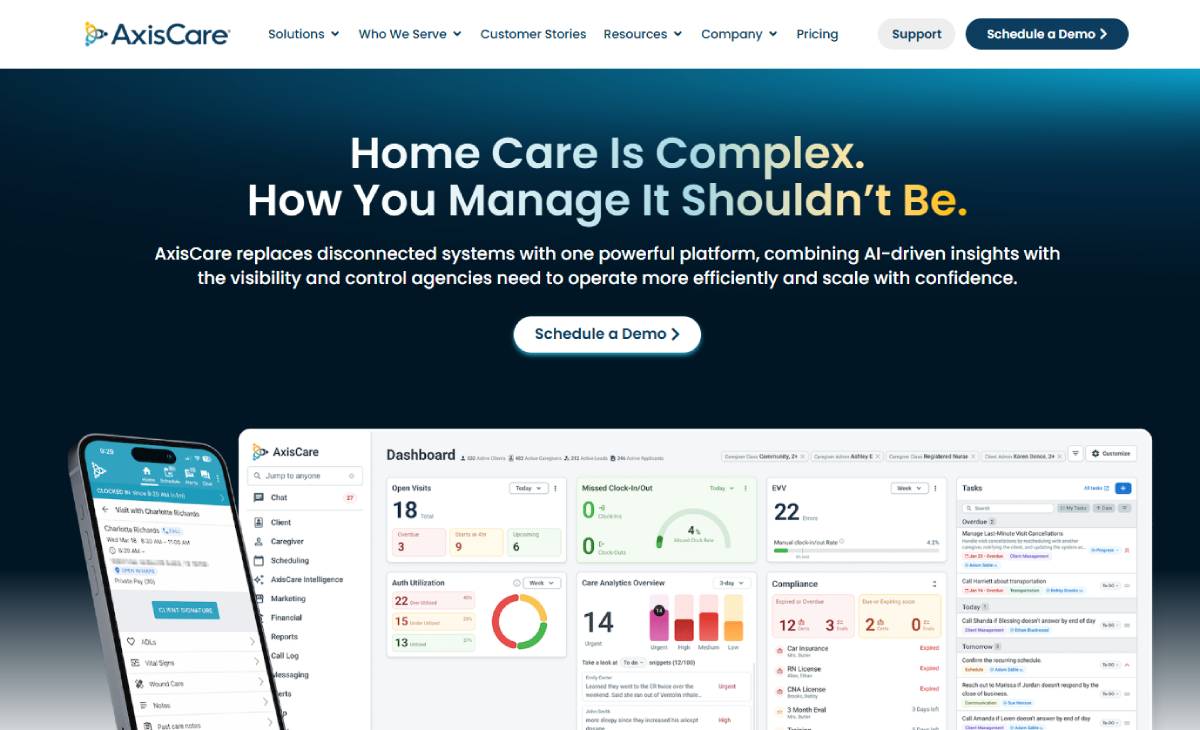
AxisCare Advances Home Care Management

AxisCare Home Care Software continues to strengthen its position as a cloud-based management platform built specifically for home care agencies.

August 5, 2026
|

A significant development in healthcare technology is reinforcing the digital transformation of home-based care services. AxisCare Home Care Software is helping agencies modernize scheduling, caregiver management, billing, and compliance, enabling healthcare providers to improve operational efficiency, enhance patient care coordination, and respond to rising demand for home healthcare services.

AxisCare Home Care Software continues to strengthen its position as a cloud-based management platform built specifically for home care agencies. The solution integrates caregiver scheduling, electronic visit verification (EVV), client management, billing, payroll, compliance tracking, and reporting into a centralized digital platform.

Healthcare providers are increasingly adopting specialized care management software to improve workforce coordination, reduce administrative burdens, and enhance service quality. Growing demand for aging-in-place services, chronic disease management, and home-based healthcare has accelerated investment in digital platforms that enable agencies to manage expanding caregiver networks while maintaining regulatory compliance and operational efficiency.

The home healthcare industry has experienced sustained growth due to aging populations, rising healthcare costs, and increasing preference for receiving care outside traditional hospital settings. Governments, healthcare providers, and insurers are encouraging home-based care models that improve patient outcomes while reducing pressure on healthcare infrastructure.

Simultaneously, healthcare organizations face mounting challenges related to caregiver shortages, regulatory compliance, workforce scheduling, reimbursement complexity, and patient documentation. These pressures have accelerated adoption of healthcare management software capable of streamlining clinical and administrative operations.

The broader digital health market continues expanding through cloud computing, mobile applications, artificial intelligence, and remote care technologies. Platforms such as AxisCare reflect this transformation by enabling agencies to automate routine workflows, improve communication between caregivers and administrators, and support more efficient delivery of personalized home healthcare services.

Healthcare technology analysts consistently identify home care management software as a critical enabler of healthcare modernization. Industry experts suggest that agencies implementing integrated digital platforms often achieve better caregiver utilization, stronger regulatory compliance, improved billing accuracy, and enhanced patient satisfaction compared with organizations relying on manual processes.

Healthcare consultants also emphasize that workforce optimization is becoming increasingly important as home care demand continues rising worldwide. Intelligent scheduling, mobile workforce management, and automated documentation help providers maintain service quality while addressing persistent labor shortages.

Industry observers further note that interoperability with electronic health records, telehealth systems, and reimbursement platforms will become increasingly valuable as healthcare ecosystems become more connected. Although individual implementation strategies vary, analysts broadly agree that digital care management platforms are becoming foundational to sustainable home healthcare operations.

For healthcare executives, AxisCare represents the broader movement toward technology-enabled care delivery that balances operational efficiency with improved patient outcomes. Agencies investing in digital management platforms may reduce administrative costs, strengthen workforce coordination, and improve compliance across increasingly complex healthcare environments.

Investors continue monitoring digital health and healthcare software providers as demand for home care services expands globally. Meanwhile, policymakers are expected to maintain focus on electronic visit verification, patient privacy, cybersecurity, healthcare reimbursement transparency, and quality-of-care standards, encouraging continued investment in secure and compliant digital healthcare infrastructure.

Looking ahead, home care management platforms are expected to integrate more artificial intelligence, predictive workforce planning, remote patient monitoring, and advanced healthcare analytics. Decision-makers should monitor evolving reimbursement policies, digital health regulations, and workforce technologies that improve care delivery efficiency. As healthcare systems increasingly shift toward community-based care, digital management platforms will remain central to long-term healthcare transformation.

Source: Crozdesk
Date: August 5, 2026

  • Featured tools
Neuron AI
Free

Neuron AI is an AI-driven content optimization platform that helps creators produce SEO-friendly content by combining semantic SEO, competitor analysis, and AI-assisted writing workflows.

#
SEO
Learn more
Alli AI
Free

Alli AI is an all-in-one, AI-powered SEO automation platform that streamlines on-page optimization, site auditing, speed improvements, schema generation, internal linking, and ranking insights.

#
SEO
Learn more

Learn more about future of AI

Join 80,000+ Ai enthusiast getting weekly updates on exciting AI tools.
Thank you! Your submission has been received!
Oops! Something went wrong while submitting the form.

AxisCare Advances Home Care Management

August 5, 2026

AxisCare Home Care Software continues to strengthen its position as a cloud-based management platform built specifically for home care agencies.

A significant development in healthcare technology is reinforcing the digital transformation of home-based care services. AxisCare Home Care Software is helping agencies modernize scheduling, caregiver management, billing, and compliance, enabling healthcare providers to improve operational efficiency, enhance patient care coordination, and respond to rising demand for home healthcare services.

AxisCare Home Care Software continues to strengthen its position as a cloud-based management platform built specifically for home care agencies. The solution integrates caregiver scheduling, electronic visit verification (EVV), client management, billing, payroll, compliance tracking, and reporting into a centralized digital platform.

Healthcare providers are increasingly adopting specialized care management software to improve workforce coordination, reduce administrative burdens, and enhance service quality. Growing demand for aging-in-place services, chronic disease management, and home-based healthcare has accelerated investment in digital platforms that enable agencies to manage expanding caregiver networks while maintaining regulatory compliance and operational efficiency.

The home healthcare industry has experienced sustained growth due to aging populations, rising healthcare costs, and increasing preference for receiving care outside traditional hospital settings. Governments, healthcare providers, and insurers are encouraging home-based care models that improve patient outcomes while reducing pressure on healthcare infrastructure.

Simultaneously, healthcare organizations face mounting challenges related to caregiver shortages, regulatory compliance, workforce scheduling, reimbursement complexity, and patient documentation. These pressures have accelerated adoption of healthcare management software capable of streamlining clinical and administrative operations.

The broader digital health market continues expanding through cloud computing, mobile applications, artificial intelligence, and remote care technologies. Platforms such as AxisCare reflect this transformation by enabling agencies to automate routine workflows, improve communication between caregivers and administrators, and support more efficient delivery of personalized home healthcare services.

Healthcare technology analysts consistently identify home care management software as a critical enabler of healthcare modernization. Industry experts suggest that agencies implementing integrated digital platforms often achieve better caregiver utilization, stronger regulatory compliance, improved billing accuracy, and enhanced patient satisfaction compared with organizations relying on manual processes.

Healthcare consultants also emphasize that workforce optimization is becoming increasingly important as home care demand continues rising worldwide. Intelligent scheduling, mobile workforce management, and automated documentation help providers maintain service quality while addressing persistent labor shortages.

Industry observers further note that interoperability with electronic health records, telehealth systems, and reimbursement platforms will become increasingly valuable as healthcare ecosystems become more connected. Although individual implementation strategies vary, analysts broadly agree that digital care management platforms are becoming foundational to sustainable home healthcare operations.

For healthcare executives, AxisCare represents the broader movement toward technology-enabled care delivery that balances operational efficiency with improved patient outcomes. Agencies investing in digital management platforms may reduce administrative costs, strengthen workforce coordination, and improve compliance across increasingly complex healthcare environments.

Investors continue monitoring digital health and healthcare software providers as demand for home care services expands globally. Meanwhile, policymakers are expected to maintain focus on electronic visit verification, patient privacy, cybersecurity, healthcare reimbursement transparency, and quality-of-care standards, encouraging continued investment in secure and compliant digital healthcare infrastructure.

Looking ahead, home care management platforms are expected to integrate more artificial intelligence, predictive workforce planning, remote patient monitoring, and advanced healthcare analytics. Decision-makers should monitor evolving reimbursement policies, digital health regulations, and workforce technologies that improve care delivery efficiency. As healthcare systems increasingly shift toward community-based care, digital management platforms will remain central to long-term healthcare transformation.

Source: Crozdesk
Date: August 5, 2026

Promote Your Tool

Copy Embed Code

Similar Blogs

August 14, 2026
|

Benefitfocus Expands Digital Benefits Administration

Benefitfocus provides cloud-based technology covering benefits enrollment, administration, communications, billing, payments and data exchange.
Read more
August 14, 2026
|

Travel Agent Revenue Models Evolve Digitally

Travel agencies can earn commissions when customers book hotels, cruises, tours, vacation packages and other travel products through them. Suppliers may pay agents for generating bookings, making commissions a traditional component of agency revenue.
Read more
August 14, 2026
|

Sofon Advances Guided Selling CPQ Automation

Sofon's platform combines guided selling, product configuration, pricing, quotation and sales-management capabilities. Guided questionnaires help sales teams identify customer requirements and translate them into suitable product configurations.
Read more
August 14, 2026
|

WellRyde Advances Medical Transportation Management

WellRyde provides technology for managing non-emergency medical transportation operations, including trip scheduling, dispatch coordination, transportation-provider management and reporting.
Read more
August 14, 2026
|

Review WAVE Advances Digital Patient Engagement

Review WAVE provides healthcare practices with tools for online appointment scheduling, two-way texting, automated appointment reminders, digital forms, web chat, marketing campaigns and online review generation.
Read more
August 14, 2026
|

Edgenuity Expands Digital Virtual Education

Edgenuity provides digital curriculum and learning solutions covering core academic subjects, electives, Advanced Placement and career-oriented education.
Read more