
Auralis AI Accelerates Customer Support Automation

Auralis AI sits within a rapidly expanding market for artificial intelligence tools designed to improve customer service operations.

August 10, 2026
|

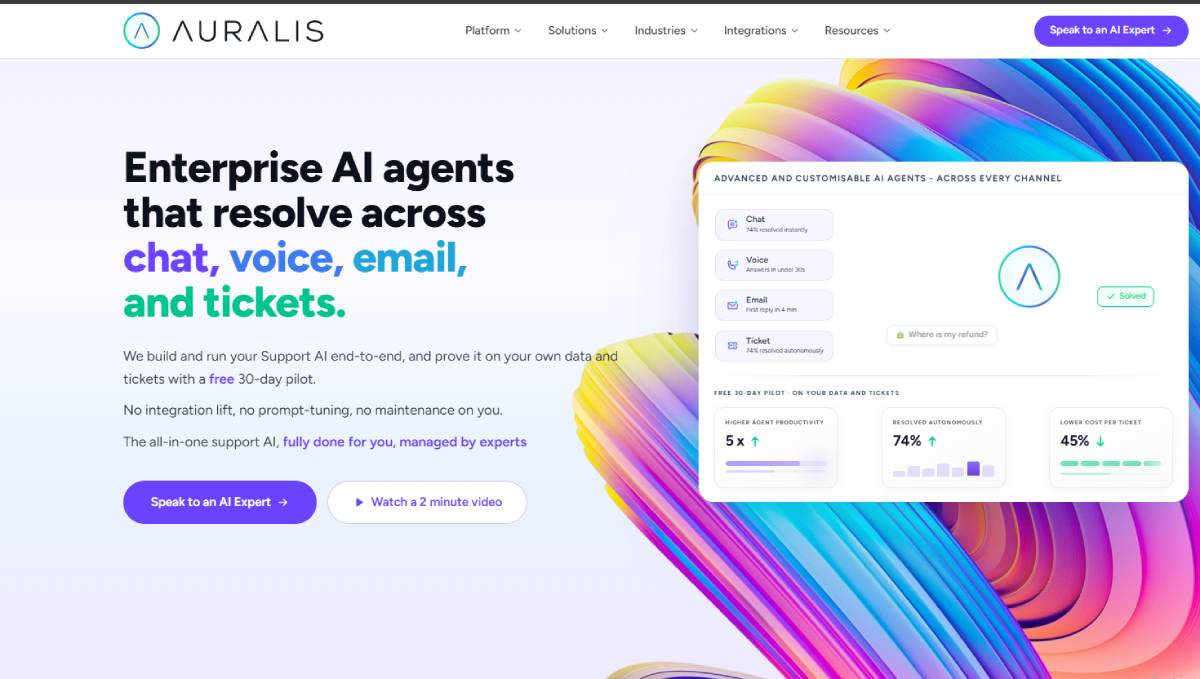
Auralis AI reflects the growing shift toward AI-powered customer support, helping businesses automate interactions, streamline service workflows, and improve response efficiency. As enterprises face rising customer expectations and pressure to control operating costs, AI-driven support platforms are becoming increasingly relevant to executives seeking scalable, always-on customer engagement.

Auralis AI sits within a rapidly expanding market for artificial intelligence tools designed to improve customer service operations. Its positioning highlights the broader move from traditional support models toward automated, intelligent customer interactions.

For businesses, the appeal is centered on reducing repetitive workloads while maintaining faster responses across customer touchpoints. AI-based systems can assist with handling routine inquiries, organizing support processes, and enabling service teams to focus on higher-value cases.

The development also reflects growing enterprise interest in deploying AI beyond experimentation and into operational functions where measurable productivity gains can be achieved.

The development aligns with a broader trend across global markets where companies are integrating AI into customer-facing operations. Customer service has emerged as a particularly attractive area because large volumes of repetitive interactions can potentially be automated without completely replacing human oversight.

Enterprises are simultaneously facing pressure from higher service expectations, growing digital engagement, and the need to manage labor and technology costs. This environment is accelerating investment in conversational AI, workflow automation, knowledge management, and intelligent service platforms.

For CXOs, the strategic importance extends beyond faster responses. Customer-support data can provide valuable insights into recurring problems, product demand, customer sentiment, and operational inefficiencies. AI therefore has the potential to connect service operations with broader business intelligence.

However, adoption also introduces challenges around data privacy, accuracy, security, transparency, and responsible AI governance. Companies must balance automation with appropriate human intervention.

Industry analysts increasingly view customer support as one of the most practical enterprise applications for generative and conversational AI. The strongest business cases typically emerge when automation is applied to repetitive, high-volume activities while complex or sensitive interactions remain under human supervision.

From an executive perspective, the key measurement areas include response time, resolution rates, customer satisfaction, employee productivity, and overall service costs. Simply deploying an AI assistant does not guarantee business value; organizations must connect the technology to measurable operational outcomes.

Enterprise leaders are also expected to scrutinize how customer information is processed and stored. AI systems operating in customer-service environments can interact with sensitive personal and commercial information, increasing the importance of security controls and governance.

The broader market suggests that successful providers will need to combine automation with reliability, contextual understanding, integration capabilities, and strong human escalation mechanisms.

For global executives, AI-driven customer support could reshape service strategies by allowing organizations to handle greater interaction volumes without expanding support operations at the same rate. Companies may also benefit from more consistent responses and faster service availability.

Investors will increasingly evaluate whether AI software companies can demonstrate sustainable productivity improvements rather than relying solely on AI-related positioning. For consumers, automation could deliver quicker assistance, but poor implementation may create frustration when customers cannot reach human representatives for complex issues.

Regulators and policymakers will continue to focus on data protection, algorithmic accountability, transparency, and responsible AI deployment. Businesses adopting these technologies should therefore establish clear governance frameworks alongside automation strategies.

The next phase of AI-powered customer service is likely to focus on deeper workflow integration, better contextual understanding, and seamless collaboration between AI agents and human teams. Decision-makers should watch adoption rates, measurable cost savings, customer satisfaction, security standards, and regulatory developments. The competitive advantage will increasingly belong to companies that use AI to enhance service quality not simply automate conversations.

Source: Crozdesk
Date: August 10, 2026

  • Featured tools
Symphony Ayasdi AI
Free

SymphonyAI Sensa is an AI-powered surveillance and financial crime detection platform that surfaces hidden risk behavior through explainable, AI-driven analytics.

#
Finance
Learn more
Copy Ai
Free

Copy AI is one of the most popular AI writing tools designed to help professionals create high-quality content quickly. Whether you are a product manager drafting feature descriptions or a marketer creating ad copy, Copy AI can save hours of work while maintaining creativity and tone.

#
Copywriting
Learn more

Learn more about future of AI

Join 80,000+ Ai enthusiast getting weekly updates on exciting AI tools.
Thank you! Your submission has been received!
Oops! Something went wrong while submitting the form.

Auralis AI Accelerates Customer Support Automation

August 10, 2026

Auralis AI sits within a rapidly expanding market for artificial intelligence tools designed to improve customer service operations.

Auralis AI reflects the growing shift toward AI-powered customer support, helping businesses automate interactions, streamline service workflows, and improve response efficiency. As enterprises face rising customer expectations and pressure to control operating costs, AI-driven support platforms are becoming increasingly relevant to executives seeking scalable, always-on customer engagement.

Auralis AI sits within a rapidly expanding market for artificial intelligence tools designed to improve customer service operations. Its positioning highlights the broader move from traditional support models toward automated, intelligent customer interactions.

For businesses, the appeal is centered on reducing repetitive workloads while maintaining faster responses across customer touchpoints. AI-based systems can assist with handling routine inquiries, organizing support processes, and enabling service teams to focus on higher-value cases.

The development also reflects growing enterprise interest in deploying AI beyond experimentation and into operational functions where measurable productivity gains can be achieved.

The development aligns with a broader trend across global markets where companies are integrating AI into customer-facing operations. Customer service has emerged as a particularly attractive area because large volumes of repetitive interactions can potentially be automated without completely replacing human oversight.

Enterprises are simultaneously facing pressure from higher service expectations, growing digital engagement, and the need to manage labor and technology costs. This environment is accelerating investment in conversational AI, workflow automation, knowledge management, and intelligent service platforms.

For CXOs, the strategic importance extends beyond faster responses. Customer-support data can provide valuable insights into recurring problems, product demand, customer sentiment, and operational inefficiencies. AI therefore has the potential to connect service operations with broader business intelligence.

However, adoption also introduces challenges around data privacy, accuracy, security, transparency, and responsible AI governance. Companies must balance automation with appropriate human intervention.

Industry analysts increasingly view customer support as one of the most practical enterprise applications for generative and conversational AI. The strongest business cases typically emerge when automation is applied to repetitive, high-volume activities while complex or sensitive interactions remain under human supervision.

From an executive perspective, the key measurement areas include response time, resolution rates, customer satisfaction, employee productivity, and overall service costs. Simply deploying an AI assistant does not guarantee business value; organizations must connect the technology to measurable operational outcomes.

Enterprise leaders are also expected to scrutinize how customer information is processed and stored. AI systems operating in customer-service environments can interact with sensitive personal and commercial information, increasing the importance of security controls and governance.

The broader market suggests that successful providers will need to combine automation with reliability, contextual understanding, integration capabilities, and strong human escalation mechanisms.

For global executives, AI-driven customer support could reshape service strategies by allowing organizations to handle greater interaction volumes without expanding support operations at the same rate. Companies may also benefit from more consistent responses and faster service availability.

Investors will increasingly evaluate whether AI software companies can demonstrate sustainable productivity improvements rather than relying solely on AI-related positioning. For consumers, automation could deliver quicker assistance, but poor implementation may create frustration when customers cannot reach human representatives for complex issues.

Regulators and policymakers will continue to focus on data protection, algorithmic accountability, transparency, and responsible AI deployment. Businesses adopting these technologies should therefore establish clear governance frameworks alongside automation strategies.

The next phase of AI-powered customer service is likely to focus on deeper workflow integration, better contextual understanding, and seamless collaboration between AI agents and human teams. Decision-makers should watch adoption rates, measurable cost savings, customer satisfaction, security standards, and regulatory developments. The competitive advantage will increasingly belong to companies that use AI to enhance service quality not simply automate conversations.

Source: Crozdesk
Date: August 10, 2026

Promote Your Tool

Copy Embed Code

Similar Blogs

August 10, 2026
|

Order Management Software Drives Smarter Commerce

The order management software landscape encompasses platforms designed to coordinate the full lifecycle of customer orders, from placement and processing to fulfillment and delivery.
Read more
August 10, 2026
|

WealthEngine Advances Wealth Management Intelligence

WealthEngine is positioned around wealth intelligence and audience analytics, providing organizations with data designed to support prospect identification, segmentation and engagement.
Read more
August 10, 2026
|

Incentive Software Reshapes Enterprise Performance Management

The incentive compensation management market is centered on software designed to automate the planning, calculation and administration of performance-based compensation.
Read more
August 10, 2026
|

Lendflow Expands Embedded Lending Infrastructure

Lendflow provides infrastructure designed to connect businesses with lending partners and financing products through digital platforms.
Read more
August 10, 2026
|

Cybersecurity Comparison Highlights Enterprise Protection Shifts

The comparison brings together three security-focused offerings with different market positions and capabilities. U.S.T.A. appears within Crozdesk’s Cyber & Data Security category.
Read more
August 10, 2026
|

Auralis AI Accelerates Customer Support Automation

Auralis AI sits within a rapidly expanding market for artificial intelligence tools designed to improve customer service operations.
Read more