



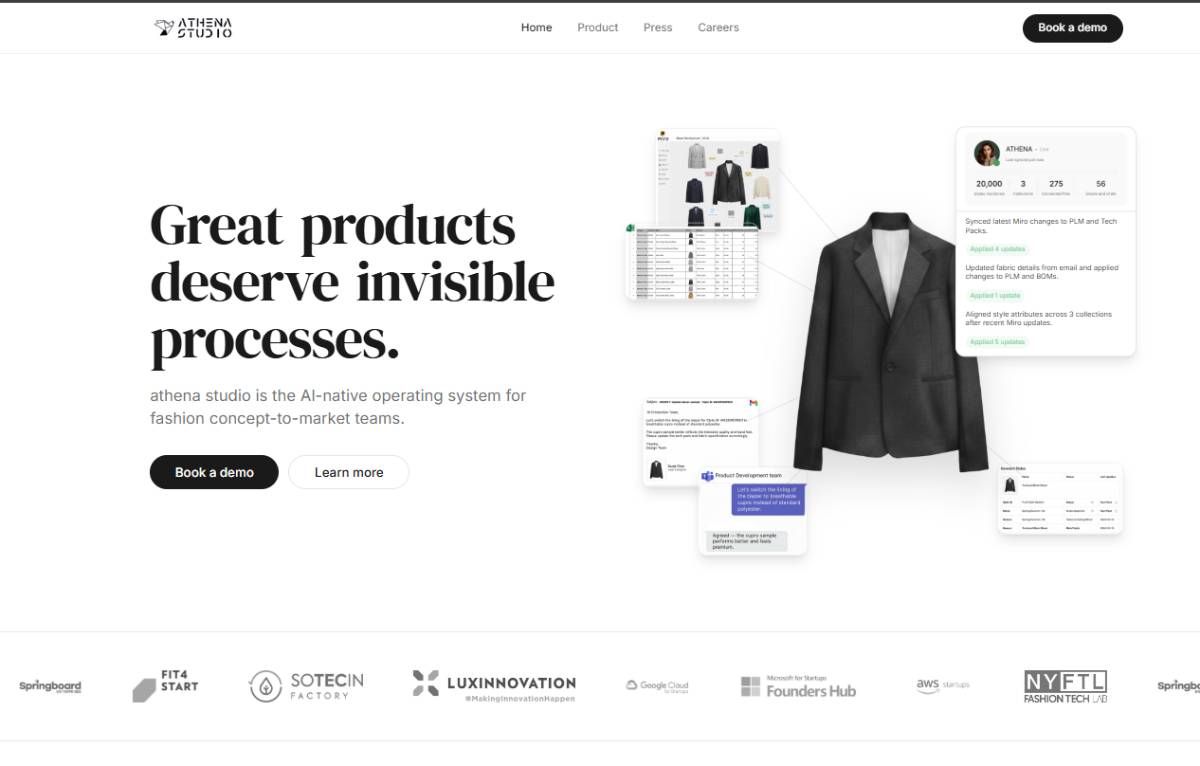
Luxembourg-based Athena Studio is leveraging artificial intelligence to transform fashion product management through an AI-powered product assistant. By streamlining product creation, merchandising, and content workflows, the startup addresses growing demands for speed, efficiency, and data-driven decision-making across the global fashion industry, offering retailers a competitive edge in an increasingly digital marketplace.
Athena Studio has introduced an AI-powered product assistant designed to simplify and automate critical product management tasks for fashion brands and retailers. The platform helps generate product information, organize catalogues, improve merchandising processes, and accelerate content creation while reducing manual administrative work.
Rather than replacing creative teams, the solution enables designers, product managers, and merchandising professionals to focus on strategic decision-making and innovation. By integrating AI into day-to-day operations, Athena Studio seeks to improve operational efficiency, shorten product development cycles, and enhance customer experiences. The initiative reflects Luxembourg's expanding ecosystem of AI startups building practical enterprise solutions with global commercial potential.
The global fashion industry is undergoing rapid digital transformation as brands seek to modernize operations, improve supply chain visibility, and personalize customer experiences. Artificial intelligence has become an increasingly valuable tool across product development, inventory management, demand forecasting, visual merchandising, and e-commerce optimization.
Retailers face growing pressure to launch products faster while managing expanding digital catalogues and omnichannel sales strategies. At the same time, consumers expect richer product information, personalized recommendations, and seamless online shopping experiences.
The development aligns with a broader trend across global markets where AI is moving beyond customer-facing applications into core enterprise operations. Fashion companies increasingly view automation as essential for improving productivity while controlling costs. Luxembourg's technology ecosystem has also become an attractive base for startups developing specialized AI solutions capable of serving international industries beyond the country's domestic market.
Industry analysts believe AI will fundamentally reshape product lifecycle management across fashion and retail by automating repetitive workflows while enabling faster, more informed business decisions. Rather than replacing human creativity, experts argue that AI performs best when supporting merchandising teams with data analysis, content generation, and operational efficiency.
Athena Studio reflects this emerging approach by positioning AI as a collaborative assistant for product professionals instead of a substitute for creative expertise. Retail technology specialists note that intelligent product management systems can reduce time-to-market, improve catalogue accuracy, and strengthen customer engagement through higher-quality digital content.
Executives across the retail sector increasingly recognize that AI adoption must balance automation with brand identity, creativity, and responsible data governance.
For fashion brands and retailers, AI-powered product assistants offer opportunities to improve productivity, reduce operational costs, and accelerate product launches without expanding administrative resources. Businesses adopting intelligent workflow automation may gain competitive advantages through faster merchandising cycles and improved customer experiences.
Investors are likely to continue supporting enterprise AI startups that solve industry-specific operational challenges with scalable software platforms. Policymakers may also encourage innovation that strengthens digital competitiveness while promoting responsible AI deployment across consumer industries.
For executives, Athena Studio demonstrates how vertical AI applications are becoming strategic business tools capable of delivering measurable operational and commercial value.
As AI adoption accelerates across retail and fashion, demand for intelligent product management platforms is expected to expand significantly. Decision-makers should monitor advancements in generative AI, digital merchandising, and enterprise workflow automation that could reshape competitive dynamics across the industry. Companies capable of combining operational efficiency with human creativity are likely to lead the next phase of fashion technology innovation.
Source: Silicon Luxembourg
Date: July 14, 2026


