
Arkeon Tackles Quantum Qubit Defects

Arkeon’s €594K seed round will be directed toward solving yield instability in qubit fabrication, a persistent challenge in scalable quantum systems.

July 2, 2026
|
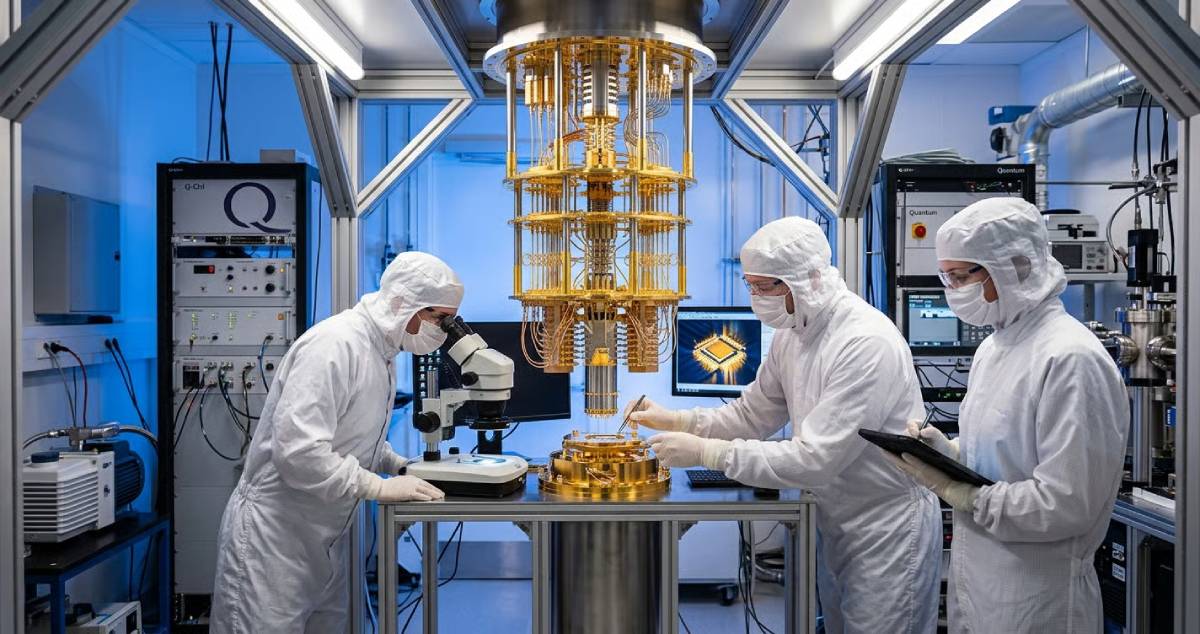
Image Source: Nordictech news

A new quantum computing startup, Arkeon, has raised €594,000 in seed funding to address a fundamental limitation in qubit reliability. The funding underscores rising investor attention on hardware-level quantum bottlenecks, with implications for next-generation computing, semiconductor supply chains, and Europe’s positioning in the global quantum race.

Arkeon’s €594K seed round will be directed toward solving yield instability in qubit fabrication, a persistent challenge in scalable quantum systems. The company is working closely with research ecosystems in Sweden, including academic collaboration tied to quantum engineering groups at institutions such as Chalmers University of Technology.

The startup aims to improve error rates that currently limit commercial viability of quantum processors. Investors backing the round include early-stage deep-tech funds focused on compute infrastructure. The funding arrives at a time when quantum hardware firms are shifting from theoretical demonstrations to manufacturable systems, where even marginal gains in stability can define commercial success or failure.

Quantum computing has reached an inflection point where algorithmic progress is increasingly constrained by physical hardware imperfections. While major global players focus on scaling qubit counts, a parallel race is emerging around improving “yield” the percentage of functional qubits produced during fabrication.

This shift is critical because even minor defects at the quantum level can cascade into exponential error rates, undermining computation reliability. Europe has positioned itself as a research-heavy but commercialization-light region in quantum technologies, with Sweden, Germany, and France investing heavily in deep-tech spinouts.

Arkeon’s approach reflects a broader industry pivot: instead of chasing raw qubit volume, startups are now targeting manufacturability and industrial reproducibility. This mirrors earlier semiconductor evolution, where yield optimization became the decisive factor in global chip dominance.

Industry analysts argue that qubit yield optimization could become the “silent bottleneck” of quantum commercialization. Unlike software-layer advances, hardware-level improvements require sustained engineering breakthroughs and long development cycles.

A recurring view among quantum researchers is that scaling without stability is economically meaningless, as error-correction overheads quickly erase performance gains. Academic voices in Europe’s quantum ecosystem have increasingly emphasized fabrication science over purely theoretical qubit expansion.

While Arkeon has not disclosed full technical specifications publicly, early investor commentary highlights confidence in its focus on manufacturability rather than speculative algorithmic advantage. Experts suggest this positions the company within a growing class of “quantum infrastructure” startups that may ultimately determine which hardware platforms survive long-term industrial competition.

For investors, Arkeon’s progress signals a shift toward capital-intensive but foundational layers of quantum computing, where returns depend on solving engineering constraints rather than software differentiation. Semiconductor and advanced manufacturing sectors may also see spillover innovation from qubit fabrication techniques.

For policymakers in Europe, such startups reinforce the strategic importance of retaining deep-tech talent and scaling pilot research into industrial output. Governments may increasingly prioritize funding for fabrication infrastructure over pure academic research.

For global technology firms, the development suggests that quantum readiness timelines remain uncertain, and supply-chain style dependencies may emerge around specialized hardware providers.

The next phase for Arkeon will likely focus on validating yield improvements at scale and securing larger institutional backing. Progress in reproducibility will determine whether the startup can transition from research-stage innovation to industrial relevance. Investors will closely monitor whether its approach reduces error correction overheads meaningfully. In the broader market, breakthroughs in qubit stability may become the true gatekeeper for commercial quantum computing timelines.

Source: Nordictech news
Date: July 2, 2026

  • Featured tools
Surfer AI
Free

Surfer AI is an AI-powered content creation assistant built into the Surfer SEO platform, designed to generate SEO-optimized articles from prompts, leveraging data from search results to inform tone, structure, and relevance.

#
SEO
Learn more
Writesonic AI
Free

Writesonic AI is a versatile AI writing platform designed for marketers, entrepreneurs, and content creators. It helps users create blog posts, ad copies, product descriptions, social media posts, and more with ease. With advanced AI models and user-friendly tools, Writesonic streamlines content production and saves time for busy professionals.

#
Copywriting
Learn more

Learn more about future of AI

Join 80,000+ Ai enthusiast getting weekly updates on exciting AI tools.
Thank you! Your submission has been received!
Oops! Something went wrong while submitting the form.

Arkeon Tackles Quantum Qubit Defects

July 2, 2026

Arkeon’s €594K seed round will be directed toward solving yield instability in qubit fabrication, a persistent challenge in scalable quantum systems.

Image Source: Nordictech news

A new quantum computing startup, Arkeon, has raised €594,000 in seed funding to address a fundamental limitation in qubit reliability. The funding underscores rising investor attention on hardware-level quantum bottlenecks, with implications for next-generation computing, semiconductor supply chains, and Europe’s positioning in the global quantum race.

Arkeon’s €594K seed round will be directed toward solving yield instability in qubit fabrication, a persistent challenge in scalable quantum systems. The company is working closely with research ecosystems in Sweden, including academic collaboration tied to quantum engineering groups at institutions such as Chalmers University of Technology.

The startup aims to improve error rates that currently limit commercial viability of quantum processors. Investors backing the round include early-stage deep-tech funds focused on compute infrastructure. The funding arrives at a time when quantum hardware firms are shifting from theoretical demonstrations to manufacturable systems, where even marginal gains in stability can define commercial success or failure.

Quantum computing has reached an inflection point where algorithmic progress is increasingly constrained by physical hardware imperfections. While major global players focus on scaling qubit counts, a parallel race is emerging around improving “yield” the percentage of functional qubits produced during fabrication.

This shift is critical because even minor defects at the quantum level can cascade into exponential error rates, undermining computation reliability. Europe has positioned itself as a research-heavy but commercialization-light region in quantum technologies, with Sweden, Germany, and France investing heavily in deep-tech spinouts.

Arkeon’s approach reflects a broader industry pivot: instead of chasing raw qubit volume, startups are now targeting manufacturability and industrial reproducibility. This mirrors earlier semiconductor evolution, where yield optimization became the decisive factor in global chip dominance.

Industry analysts argue that qubit yield optimization could become the “silent bottleneck” of quantum commercialization. Unlike software-layer advances, hardware-level improvements require sustained engineering breakthroughs and long development cycles.

A recurring view among quantum researchers is that scaling without stability is economically meaningless, as error-correction overheads quickly erase performance gains. Academic voices in Europe’s quantum ecosystem have increasingly emphasized fabrication science over purely theoretical qubit expansion.

While Arkeon has not disclosed full technical specifications publicly, early investor commentary highlights confidence in its focus on manufacturability rather than speculative algorithmic advantage. Experts suggest this positions the company within a growing class of “quantum infrastructure” startups that may ultimately determine which hardware platforms survive long-term industrial competition.

For investors, Arkeon’s progress signals a shift toward capital-intensive but foundational layers of quantum computing, where returns depend on solving engineering constraints rather than software differentiation. Semiconductor and advanced manufacturing sectors may also see spillover innovation from qubit fabrication techniques.

For policymakers in Europe, such startups reinforce the strategic importance of retaining deep-tech talent and scaling pilot research into industrial output. Governments may increasingly prioritize funding for fabrication infrastructure over pure academic research.

For global technology firms, the development suggests that quantum readiness timelines remain uncertain, and supply-chain style dependencies may emerge around specialized hardware providers.

The next phase for Arkeon will likely focus on validating yield improvements at scale and securing larger institutional backing. Progress in reproducibility will determine whether the startup can transition from research-stage innovation to industrial relevance. Investors will closely monitor whether its approach reduces error correction overheads meaningfully. In the broader market, breakthroughs in qubit stability may become the true gatekeeper for commercial quantum computing timelines.

Source: Nordictech news
Date: July 2, 2026

Promote Your Tool

Copy Embed Code

Similar Blogs

July 2, 2026
|

Switzerland Delays e-ID Security Upgrade

Swiss authorities have postponed the introduction of the national e-ID system, originally planned as part of the country’s digital transformation agenda.
Read more
July 2, 2026
|

ICEYE Raises €1B Space Eyes

ICEYE, a Finnish space technology company, has raised €1 billion in a major funding round led by General Atlantic.
Read more
July 2, 2026
|

Rotomate Replaces Factory Expertise AI

Rotomate, an industrial AI startup, has raised €2.1 million in pre-seed funding to address a growing workforce challenge in manufacturing: the retirement of experienced factory specialists.
Read more
July 2, 2026
|

Skyfora Builds Telecom Climate Intelligence

Skyfora has secured €6.5 million in fresh funding to expand its satellite-assisted weather intelligence platform. The company leverages GNSS signal distortion data from telecom infrastructure to generate hyper-local weather insights.
Read more
July 2, 2026
|

Omda Expands Public Safety Stack

Omda has acquired a public safety and emergency software division from Saab, a unit focused on critical incident management and emergency response systems.
Read more
July 2, 2026
|

Nordic Capital Backs Defense Tech

Sandwater, in partnership with Gardar Fund, has secured €80 million in fresh capital commitments aimed at Ukrainian defense and dual-use technology startups.
Read more