



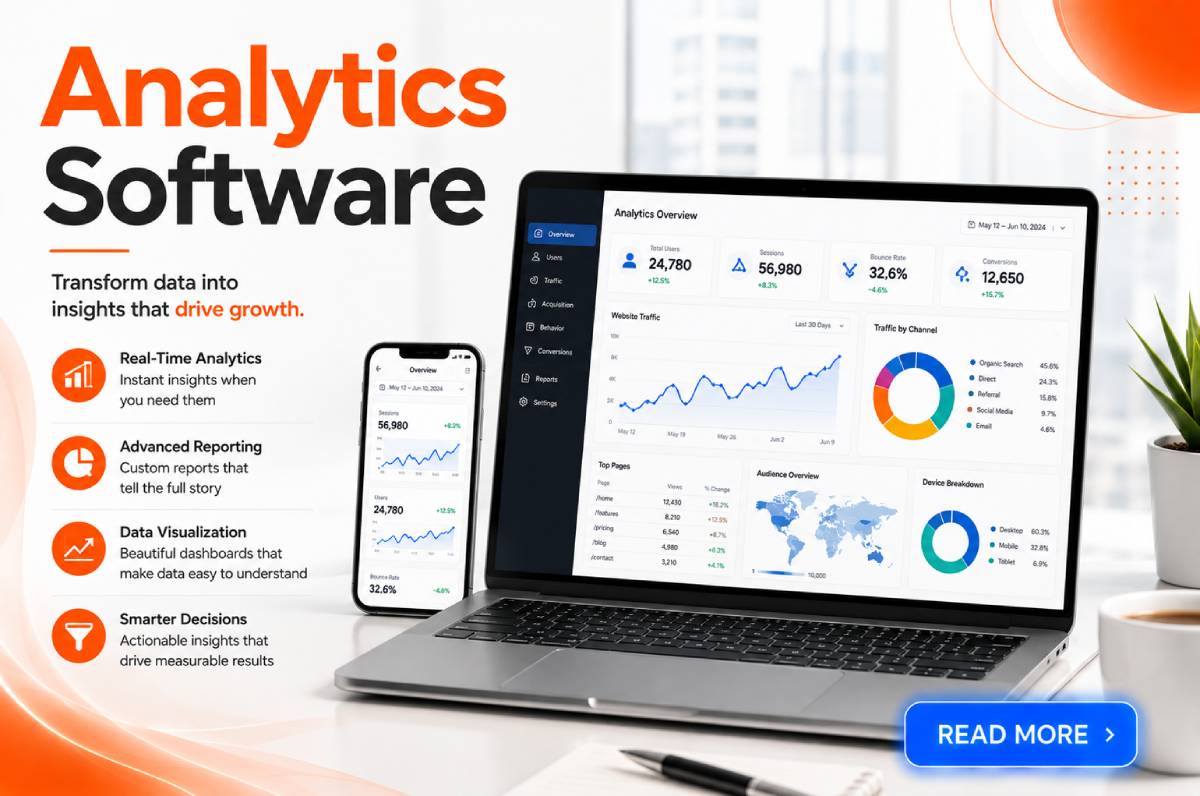
Analytics software is becoming a strategic pillar of modern enterprise decision-making as organizations seek faster access to actionable business intelligence. From operational reporting and visualization to predictive analysis and real-time insights, analytics platforms are helping executives turn increasingly complex datasets into measurable business outcomes and more informed strategic decisions.
The analytics software market encompasses platforms designed to collect, process, visualize, analyze, and interpret business data. Capabilities can include dashboards, reporting, data visualization, predictive analytics, business intelligence, statistical analysis, and automated insights.
Organizations across finance, healthcare, retail, manufacturing, technology, and professional services are increasingly using analytics to monitor performance and identify emerging opportunities or risks.
The market is also evolving alongside cloud computing and artificial intelligence. Modern platforms increasingly emphasize automation, self-service analytics, real-time data processing, and AI-assisted insights, reducing dependence on specialized technical teams.
For enterprise leaders, the shift means analytics is moving beyond retrospective reporting toward continuous decision support, operational intelligence, and predictive business planning.
The rise of analytics software reflects the rapid expansion of enterprise data. Organizations now generate information across customer interactions, digital platforms, financial systems, supply chains, connected devices, and internal operations. Converting that data into usable intelligence has therefore become a strategic priority.
Historically, business analytics was dominated by centralized reporting teams and complex business-intelligence systems. The emergence of cloud-based platforms has broadened access, allowing business users to interact with dashboards and analytical tools without relying entirely on IT departments.
Artificial intelligence is accelerating this transition. Automated pattern recognition, natural-language queries, predictive models, and machine-learning capabilities are increasingly being integrated into analytics environments.
The development aligns with a broader global trend in which executives expect technology investments to deliver measurable improvements in productivity, forecasting, customer experience, and risk management. For CXOs, analytics is consequently becoming less about producing reports and more about creating an organization capable of responding quickly to changing market conditions.
Industry analysts increasingly view analytics as an essential component of digital transformation. The strategic value comes from connecting data from multiple business functions and making insights accessible to the people responsible for operational and financial decisions.
Experts also emphasize that analytics investments must be supported by strong data governance. Poor-quality, fragmented, or inconsistent data can undermine even sophisticated analytical systems. Organizations therefore need clear ownership, standardized data definitions, security controls, and reliable integration infrastructure.
The growing use of AI introduces another layer of opportunity and risk. AI-assisted analytics can accelerate insight generation, but executives must understand how models reach conclusions and ensure that automated recommendations are based on reliable information.
From a leadership perspective, the most successful analytics strategies are likely to combine technology with organizational adoption. Employees need the skills and confidence to interpret analytical outputs and incorporate them into everyday decisions.
The emerging consensus is that analytics should function as an enterprise capability rather than an isolated technology project. For businesses, advanced analytics can improve forecasting, resource allocation, customer targeting, financial planning, supply-chain visibility, and operational efficiency. Companies can potentially identify risks earlier while discovering new opportunities through data-driven analysis.
Investors are likely to continue watching analytics providers as demand for AI-enabled business intelligence expands. Vendors that combine usability, scalability, integration, security, and automation may gain an advantage in an increasingly competitive market.
For consumers, better analytics can support more personalized services and faster responses, although increased data collection creates concerns around privacy and responsible data usage.
Policymakers face the challenge of balancing innovation with data protection, algorithmic accountability, cybersecurity, and responsible AI deployment. For executives, the priority is clear: analytical capabilities must produce trusted insights that can influence real business decisions rather than simply increasing the volume of dashboards and reports.
Analytics software is likely to become increasingly AI-driven, automated, and embedded directly into enterprise workflows. Natural-language interfaces, predictive models, real-time intelligence, and automated recommendations could make advanced analysis accessible to broader groups of employees.
Decision-makers should monitor data quality, AI reliability, cybersecurity, regulatory requirements, and integration capabilities when evaluating analytics investments. The next competitive frontier will not simply be who has the most data, but who can convert trusted data into faster, smarter, and more accountable decisions.
Source: Crozdesk
Date: August 10, 2026


