



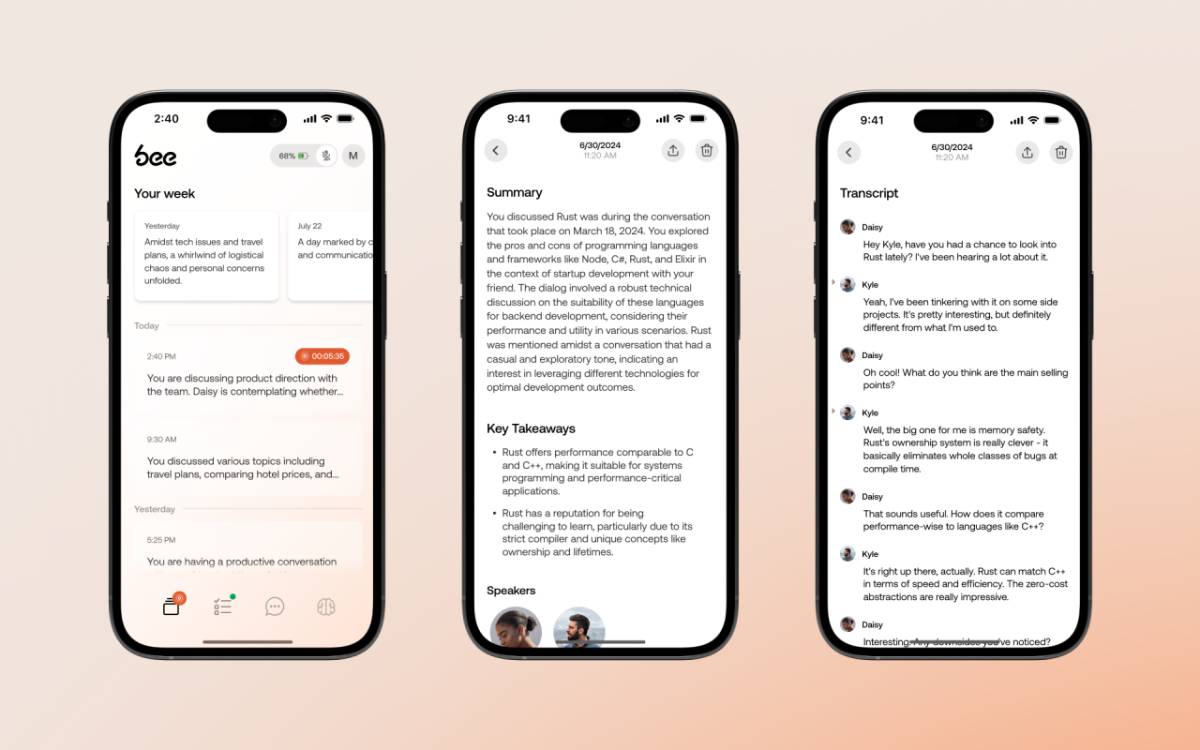
A new generation of AI-powered wearable technology is drawing both excitement and concern after early hands-on testing of Bee wearable highlighted its advanced personal-assistant capabilities alongside growing privacy anxieties. The development underscores how technology firms are accelerating efforts to integrate AI deeper into consumers’ everyday lives.
Early reviews of Amazon’s Bee wearable suggest the device is designed to function as an always-available AI companion capable of listening, processing contextual information, and assisting users with tasks throughout the day. The wearable reportedly combines voice interaction, environmental awareness, and AI-driven personalization into a compact consumer device.
Observers noted that while the product demonstrated impressive convenience features, concerns quickly emerged around constant audio monitoring, data collection practices, and the broader implications of ambient AI systems embedded into daily routines.
The rollout reflects Amazon’s broader push to strengthen its position in AI-enabled consumer hardware, an increasingly competitive market that includes efforts from Google, Meta, and Apple.
Industry analysts view wearable AI as a potentially major next frontier for digital ecosystems and consumer engagement. The emergence of AI wearables reflects a broader shift within the technology industry toward “ambient computing,” where AI systems continuously operate in the background to anticipate user needs, automate tasks, and personalize experiences in real time.
Over the past decade, smartphones evolved into the dominant digital gateway for consumers. However, technology companies increasingly believe the next computing platform may involve AI-integrated glasses, earbuds, pins, watches, and lightweight wearable devices capable of seamless contextual interaction.
The trend has accelerated due to rapid improvements in generative AI, speech recognition, edge computing, and low-power semiconductor technology. Major firms are now competing to create AI ecosystems that move beyond screens and keyboards into more natural human interaction models.
At the same time, privacy concerns surrounding always-listening devices remain unresolved. Previous controversies involving smart speakers, targeted advertising, and voice-data retention have heightened public sensitivity toward technologies that continuously collect behavioral information.
The issue is becoming central to both consumer trust and regulatory oversight. Technology analysts describe AI wearables as a potentially transformative category that could reshape how consumers interact with digital services. Supporters argue these devices may eventually function as proactive assistants capable of managing schedules, communication, navigation, shopping, and personal productivity with minimal manual input.
However, privacy advocates and cybersecurity experts warn that constant passive listening and behavioral monitoring introduce significant ethical and security risks. Specialists caution that consumers may underestimate how much personal information ambient AI systems can collect, analyze, and monetize over time.
Industry observers note that the success of AI wearables may ultimately depend less on technical capability and more on public trust. Transparency around data usage, opt-in controls, local processing, and storage practices could become decisive competitive differentiators.
Meanwhile, policy experts suggest governments are likely to intensify scrutiny of AI-enabled consumer hardware as concerns grow around surveillance, consent, and digital profiling.
Executives across the tech sector are closely monitoring whether consumers embrace or resist always-on AI experiences. For businesses, AI wearables could unlock new revenue streams through subscription services, digital commerce integration, personalized advertising, and ecosystem expansion. Companies capable of building trusted AI hardware platforms may gain strategic advantages in the next phase of consumer technology.
Retail, healthcare, productivity, and entertainment industries could also experience disruption as wearable AI becomes more integrated into daily routines and enterprise workflows.
From a regulatory standpoint, the rise of ambient AI devices may accelerate demands for stronger privacy protections, clearer disclosure requirements, and stricter controls on biometric and voice data collection. Policymakers are increasingly expected to examine how AI wearables handle consent, surveillance risks, and cross-platform data sharing.
The sector may become a major testing ground for future AI governance models. The next phase for AI wearables will likely focus on balancing convenience with consumer trust. Technology firms are expected to refine device capabilities while simultaneously addressing mounting concerns around privacy, transparency, and data security.
Executives and investors will closely watch whether AI wearables achieve mainstream adoption or encounter resistance similar to earlier smart-device experiments. The outcome could significantly influence the future direction of ambient computing and AI-driven consumer ecosystems.
Source: TechCrunch
Date: May 25, 2026


