



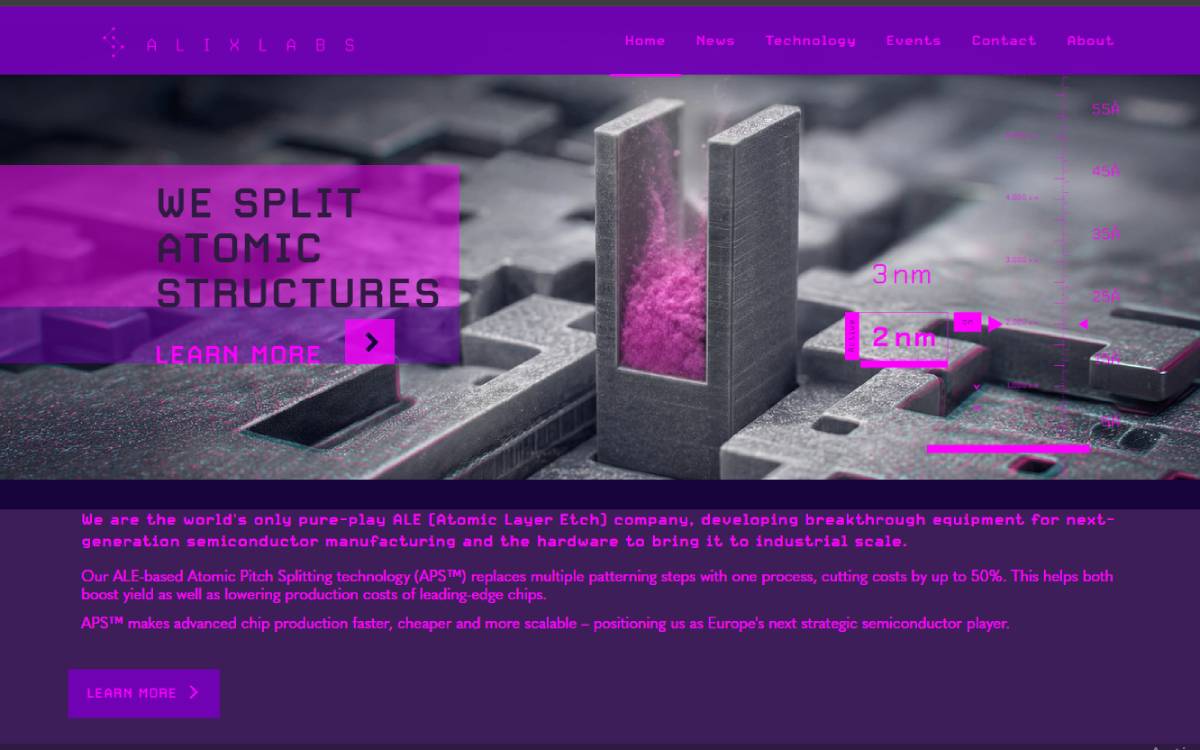
A major breakthrough is emerging in semiconductor manufacturing as Swedish deep-tech company AlixLabs secures €15 million to advance its innovative chip-scaling technology. The company aims to reduce the industry’s dependence on extremely expensive equipment by using atomic-level processes to create smaller, more efficient semiconductor structures.
AlixLabs has raised €15 million in Series A funding to commercialize its semiconductor manufacturing technology based on atomic layer etching and precision patterning techniques. The company’s approach focuses on shrinking chip features without requiring traditional next-generation lithography machines that can cost hundreds of millions of euros.
The investment will support technology development, industrial partnerships, and expansion of semiconductor applications. Based in Sweden, AlixLabs is targeting one of the biggest challenges facing the global chip industry: improving performance while controlling manufacturing costs.
The funding highlights growing investor interest in alternative semiconductor technologies capable of strengthening global chip supply chains. The semiconductor industry is entering a critical phase as demand for advanced chips continues to rise across artificial intelligence, automotive systems, cloud computing, and defense applications. However, producing smaller and more powerful chips has become increasingly expensive, with leading-edge manufacturing requiring highly specialized equipment and significant capital investment.
Traditional chip scaling depends heavily on advanced lithography systems, creating supply chain pressure and increasing barriers for semiconductor companies. As nations compete to secure domestic chip capabilities, alternative manufacturing approaches are gaining strategic importance.
AlixLabs’ technology represents a broader industry trend toward finding more efficient methods to extend semiconductor innovation beyond traditional scaling limits. The development aligns with global efforts to diversify chip production, reduce technology dependencies, and create more resilient semiconductor ecosystems.
Industry analysts consider semiconductor manufacturing innovation a key factor in maintaining competitiveness as chip demand accelerates. Technologies that improve efficiency without requiring massive infrastructure investments could provide companies with new pathways to remain competitive.
AlixLabs’ funding success demonstrates growing confidence in alternative approaches to semiconductor scaling. Investors are increasingly looking beyond established manufacturing methods toward technologies that can improve cost efficiency and manufacturing flexibility.
Experts note that while advanced lithography remains essential for the most cutting-edge chips, complementary technologies could play an important role in extending chip performance and enabling broader access to advanced manufacturing.
The company’s progress will be closely watched by semiconductor manufacturers, equipment providers, and governments seeking stronger domestic technology capabilities. For semiconductor companies, AlixLabs’ technology could provide a cost-effective pathway to improve chip performance while reducing dependence on expensive manufacturing equipment. This could benefit industries including artificial intelligence, telecommunications, automotive, and industrial automation.
Investors may view the company as part of a new generation of semiconductor innovators addressing supply chain challenges and rising production costs. From a policy perspective, the development supports global initiatives focused on semiconductor independence and technological resilience. Governments investing in chip ecosystems may increasingly support emerging manufacturing technologies that strengthen domestic capabilities and reduce reliance on limited suppliers.
AlixLabs’ next challenge will be proving that its technology can scale from laboratory innovation to commercial semiconductor production. Successful partnerships with chip manufacturers will determine its long-term impact. As global demand for advanced processors continues growing, solutions that lower manufacturing costs and improve supply chain flexibility could become critical components of the future semiconductor landscape.
Source: Nordic Tech News
Date: July 2026


