
Akinator Showcases AI Guessing Engine in Interactive Entertainment

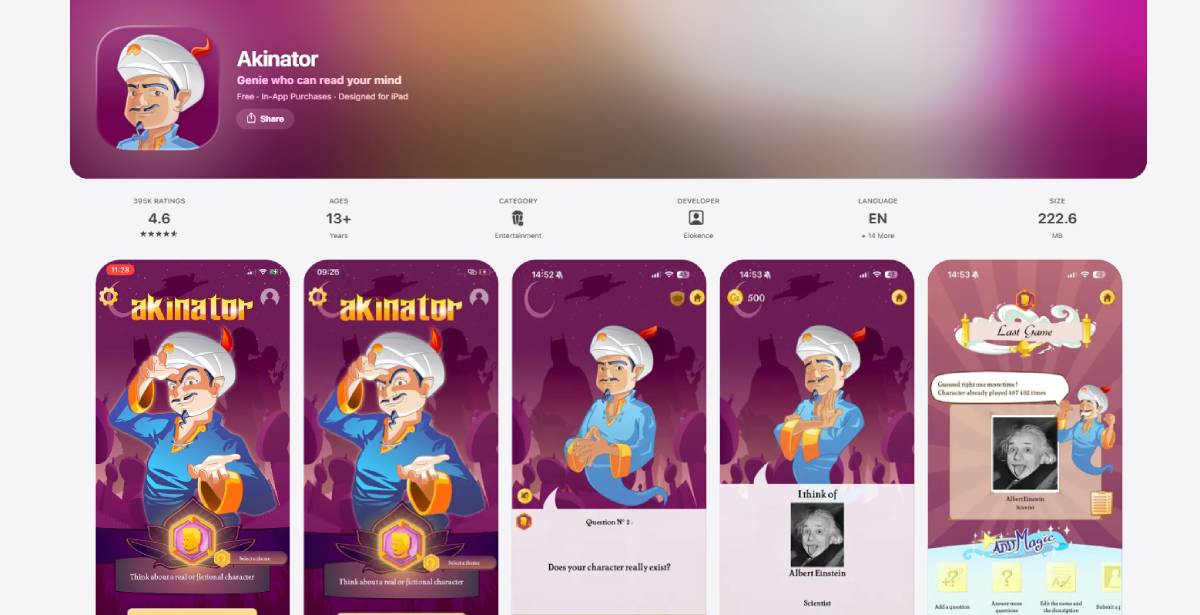
Developed by Elokence, Akinator uses an AI-driven question-and-answer system to guess characters, objects, or personalities that users have in mind.

March 30, 2026
|

A notable example of AI-powered entertainment continues to gain global traction as Akinator, the interactive guessing game app, demonstrates how artificial intelligence can power real-time decision engines for consumer engagement. The platform highlights how algorithm-driven experiences are reshaping digital entertainment, gaming innovation, and user interaction models across mobile platforms.

Developed by Elokence, Akinator uses an AI-driven question-and-answer system to guess characters, objects, or personalities that users have in mind. The application relies on a large knowledge base combined with probabilistic algorithms that analyze user responses and narrow possibilities through sequential questioning. Available globally across major mobile platforms, the app has amassed millions of downloads and remains one of the most recognizable examples of AI-based interactive gaming.

The system continuously improves as new characters and responses are added by users worldwide. This crowdsourced knowledge expansion allows the platform to refine predictions over time, demonstrating the scalability of AI models in consumer-facing applications. The success of Akinator reflects a broader evolution in digital entertainment, where artificial intelligence increasingly powers user engagement and personalization.

Originally launched as a web-based experience before expanding to mobile platforms, the game became widely known for its ability to identify characters from celebrities to fictional figures based on a small series of questions.

Its technology is built around decision-tree learning and probabilistic inference, techniques that were early precursors to more advanced AI-driven recommendation systems.

The development aligns with a broader trend across global markets where AI technologies are moving beyond enterprise software into mainstream consumer experiences. Gaming, entertainment, and mobile applications are now among the fastest-growing sectors adopting AI-driven interaction models.

For technology companies and digital publishers, platforms like Akinator demonstrate how intelligent algorithms can transform simple gameplay into highly engaging and scalable digital experiences.

Technology analysts often cite Akinator as an early demonstration of how AI-powered inference engines can be applied to entertainment. Experts note that the platform’s design asking iterative questions and refining probabilities mirrors techniques used in recommendation algorithms, search engines, and digital assistants.

Industry observers say the app’s popularity stems from its ability to create a perception of “mind reading,” which enhances user engagement and encourages repeated interaction. AI researchers also point out that the platform benefits from collective intelligence: as millions of players interact with the system, the dataset grows, improving accuracy and expanding the knowledge base.

This crowdsourced learning model has parallels with modern AI training methods, where large-scale user data helps refine algorithmic performance. For businesses, the rise of interactive AI platforms like Akinator highlights new opportunities in gamified digital engagement. Companies across entertainment, marketing, and education are increasingly exploring AI-powered interaction models to capture audience attention. The technology also demonstrates how data-driven learning systems can continuously improve through user participation an approach now widely adopted in consumer applications.

For policymakers and regulators, the growth of such platforms raises questions around data collection, algorithmic transparency, and user privacy. As AI-driven entertainment tools become more sophisticated, regulatory frameworks may evolve to ensure responsible use of consumer data and algorithmic decision systems.

Looking ahead, AI-driven interactive experiences are expected to expand beyond entertainment into education, customer support, and digital commerce. Platforms like Akinator demonstrate how simple AI concepts can evolve into globally recognized applications.

For technology leaders and investors, the key opportunity lies in applying similar engagement models across new sectors where personalization and intelligent interaction will define the next generation of digital platforms.

Source: Akinator App Listing / Elokence
Date: March 5, 2026

  • Featured tools
Upscayl AI
Free

Upscayl AI is a free, open-source AI-powered tool that enhances and upscales images to higher resolutions. It transforms blurry or low-quality visuals into sharp, detailed versions with ease.

#
Productivity
Learn more
Symphony Ayasdi AI
Free

SymphonyAI Sensa is an AI-powered surveillance and financial crime detection platform that surfaces hidden risk behavior through explainable, AI-driven analytics.

#
Finance
Learn more

Learn more about future of AI

Join 80,000+ Ai enthusiast getting weekly updates on exciting AI tools.
Thank you! Your submission has been received!
Oops! Something went wrong while submitting the form.

Akinator Showcases AI Guessing Engine in Interactive Entertainment

March 30, 2026

Developed by Elokence, Akinator uses an AI-driven question-and-answer system to guess characters, objects, or personalities that users have in mind.

A notable example of AI-powered entertainment continues to gain global traction as Akinator, the interactive guessing game app, demonstrates how artificial intelligence can power real-time decision engines for consumer engagement. The platform highlights how algorithm-driven experiences are reshaping digital entertainment, gaming innovation, and user interaction models across mobile platforms.

Developed by Elokence, Akinator uses an AI-driven question-and-answer system to guess characters, objects, or personalities that users have in mind. The application relies on a large knowledge base combined with probabilistic algorithms that analyze user responses and narrow possibilities through sequential questioning. Available globally across major mobile platforms, the app has amassed millions of downloads and remains one of the most recognizable examples of AI-based interactive gaming.

The system continuously improves as new characters and responses are added by users worldwide. This crowdsourced knowledge expansion allows the platform to refine predictions over time, demonstrating the scalability of AI models in consumer-facing applications. The success of Akinator reflects a broader evolution in digital entertainment, where artificial intelligence increasingly powers user engagement and personalization.

Originally launched as a web-based experience before expanding to mobile platforms, the game became widely known for its ability to identify characters from celebrities to fictional figures based on a small series of questions.

Its technology is built around decision-tree learning and probabilistic inference, techniques that were early precursors to more advanced AI-driven recommendation systems.

The development aligns with a broader trend across global markets where AI technologies are moving beyond enterprise software into mainstream consumer experiences. Gaming, entertainment, and mobile applications are now among the fastest-growing sectors adopting AI-driven interaction models.

For technology companies and digital publishers, platforms like Akinator demonstrate how intelligent algorithms can transform simple gameplay into highly engaging and scalable digital experiences.

Technology analysts often cite Akinator as an early demonstration of how AI-powered inference engines can be applied to entertainment. Experts note that the platform’s design asking iterative questions and refining probabilities mirrors techniques used in recommendation algorithms, search engines, and digital assistants.

Industry observers say the app’s popularity stems from its ability to create a perception of “mind reading,” which enhances user engagement and encourages repeated interaction. AI researchers also point out that the platform benefits from collective intelligence: as millions of players interact with the system, the dataset grows, improving accuracy and expanding the knowledge base.

This crowdsourced learning model has parallels with modern AI training methods, where large-scale user data helps refine algorithmic performance. For businesses, the rise of interactive AI platforms like Akinator highlights new opportunities in gamified digital engagement. Companies across entertainment, marketing, and education are increasingly exploring AI-powered interaction models to capture audience attention. The technology also demonstrates how data-driven learning systems can continuously improve through user participation an approach now widely adopted in consumer applications.

For policymakers and regulators, the growth of such platforms raises questions around data collection, algorithmic transparency, and user privacy. As AI-driven entertainment tools become more sophisticated, regulatory frameworks may evolve to ensure responsible use of consumer data and algorithmic decision systems.

Looking ahead, AI-driven interactive experiences are expected to expand beyond entertainment into education, customer support, and digital commerce. Platforms like Akinator demonstrate how simple AI concepts can evolve into globally recognized applications.

For technology leaders and investors, the key opportunity lies in applying similar engagement models across new sectors where personalization and intelligent interaction will define the next generation of digital platforms.

Source: Akinator App Listing / Elokence
Date: March 5, 2026

Promote Your Tool

Copy Embed Code

Similar Blogs

March 30, 2026
|

Meta Court Setbacks Signal Stricter AI Scrutiny

Meta faced multiple legal losses related to its AI initiatives, particularly around training data usage, algorithmic transparency, and consumer protection obligations. Courts questioned the company’s safeguards, emphasizing risks of bias, privacy violations, and misinformation.
Read more
March 30, 2026
|

Anthropic Pushes Back Against Pentagon Pressure

Anthropic, a leading AI firm, resisted Pentagon pressure to weaken or remove safeguards designed to prevent misuse of its AI systems. The confrontation escalated after Hegseth urged faster deployment of AI capabilities without certain safety constraints.
Read more
March 30, 2026
|

Digital Twin Meets AI in Mining Transformation

MineScape 2026 introduces enhanced capabilities combining AI-powered analytics with digital twin simulations to optimize mine planning and operations.
Read more
March 30, 2026
|

AI Moves Beyond Earth With Space Data Centers

Nvidia has introduced a concept for deploying AI data center hardware in space, leveraging satellite platforms and orbital infrastructure to process data closer to its source. The initiative aligns with rising demand for real-time analytics from Earth observation, telecommunications, and defense sectors.
Read more
March 30, 2026
|

AI Becomes Frontline Defense Against Spam Calls

The development aligns with a broader trend across global markets where AI is being used both to enable and combat digital fraud. Spam calls have become a widespread issue, costing consumers and businesses billions annually.
Read more
March 30, 2026
|

Bluesky Unveils AI Driven Feed Customization

The integration of AI into feed customization represents a convergence of personalization and decentralization. Historically, social media has prioritized engagement metrics over user choice.
Read more