



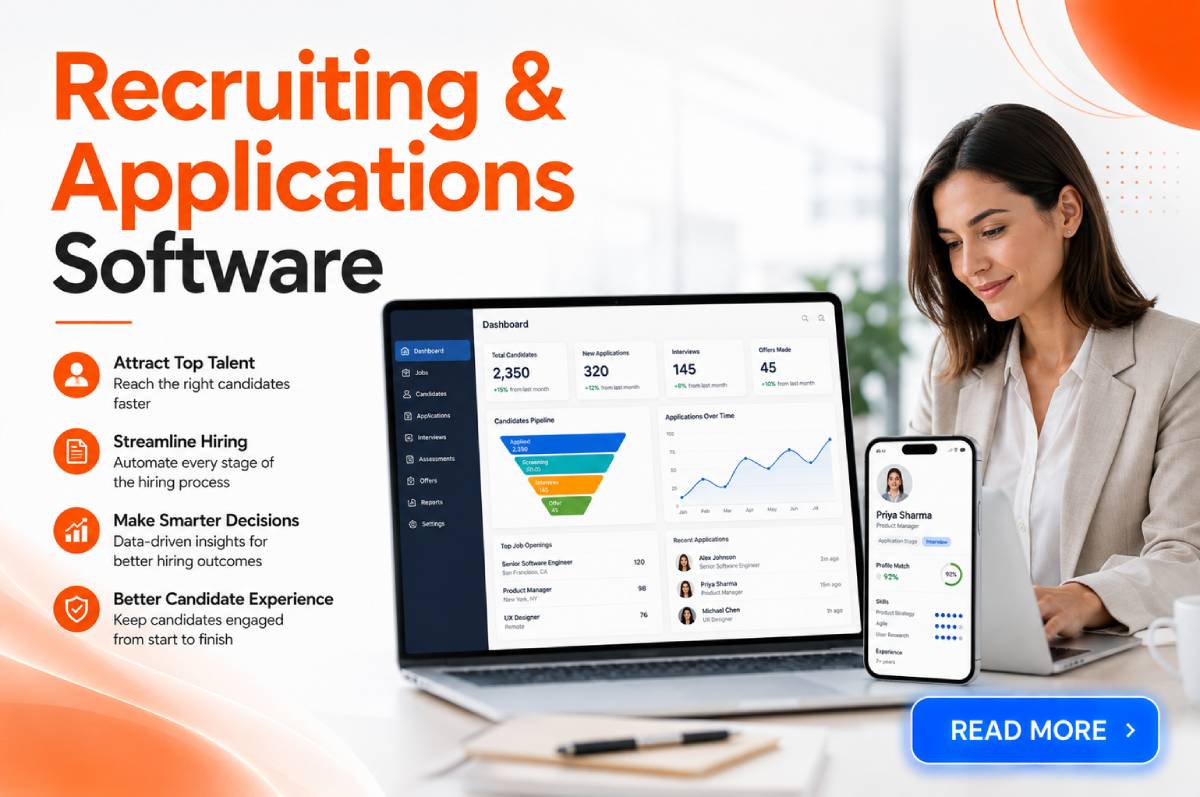
The recruiting and applications software market continues to evolve rapidly as organizations embrace cloud-based and AI-powered hiring technologies to improve recruitment efficiency, enhance candidate experiences, and address persistent talent shortages. The shift is influencing HR strategies across industries, enabling enterprises to modernize workforce planning while supporting faster, data-driven hiring decisions in increasingly competitive labor markets.
Recruiting and applications software platforms now combine applicant tracking, candidate sourcing, interview scheduling, recruitment automation, employer branding, onboarding support, and workforce analytics within integrated cloud environments. Artificial intelligence is increasingly being deployed to automate resume screening, improve candidate matching, and provide predictive hiring insights.
Organizations across technology, healthcare, finance, manufacturing, retail, education, and government sectors are expanding investments in digital recruitment infrastructure to reduce hiring timelines and improve workforce quality. As labor markets become more dynamic, enterprises are prioritizing scalable recruitment solutions that enhance collaboration among HR teams while supporting compliance with evolving employment regulations and data privacy requirements.
Global workforce dynamics have undergone substantial transformation over the past several years due to digitalization, hybrid work models, demographic shifts, and increasing competition for highly skilled professionals. Organizations are facing mounting pressure to fill vacancies more quickly while maintaining high standards for candidate quality, diversity, and compliance.
The broader human capital management industry has responded by accelerating investment in recruitment technologies that automate repetitive administrative processes while improving hiring intelligence through advanced analytics and artificial intelligence. Cloud-based recruitment ecosystems now integrate seamlessly with payroll, employee onboarding, performance management, and workforce planning systems, creating unified HR technology environments.
This transformation reflects a broader enterprise trend toward data-driven talent management, where recruitment technology is viewed not merely as an HR tool but as a strategic business capability that directly supports organizational growth, innovation, and long-term workforce resilience.
Industry analysts widely recognize recruitment technology as one of the fastest-growing segments within enterprise software. Experts note that AI-powered applicant tracking systems enable organizations to improve hiring accuracy, reduce administrative workloads, and accelerate recruitment cycles while enhancing candidate engagement through personalized communication and automated workflows.
Human resources consultants emphasize that integrated recruitment platforms provide executives with valuable workforce intelligence, enabling better forecasting of hiring needs and more informed strategic planning. At the same time, experts stress that organizations should balance automation with human oversight to promote fairness, transparency, and regulatory compliance throughout the recruitment process.
While no single corporate announcement defines the market's direction, ongoing innovation across recruiting software reflects broader enterprise priorities focused on operational efficiency, workforce agility, digital transformation, and sustainable talent acquisition strategies.
For businesses, modern recruiting platforms offer significant opportunities to reduce hiring costs, improve workforce quality, and strengthen employer branding in increasingly competitive labor markets. HR executives are expected to continue investing in automation and analytics to improve recruitment performance and organizational scalability.
Investors continue to view HR technology as an attractive growth sector driven by enterprise digital transformation and expanding demand for workforce automation. Policymakers and regulators, meanwhile, are paying closer attention to the responsible use of artificial intelligence in recruitment, emphasizing transparency, data privacy, bias mitigation, and compliance with evolving employment legislation.
Recruitment technology is expected to become increasingly intelligent as artificial intelligence, predictive analytics, and skills-based hiring continue to reshape workforce strategies. Organizations will likely prioritize platforms that integrate recruitment, workforce planning, and employee lifecycle management into unified ecosystems. Decision-makers should closely monitor regulatory developments surrounding AI-driven hiring while preparing for continued innovation that will redefine global talent acquisition over the coming years.
Source: Crozdesk
Date: August 6, 2026


