



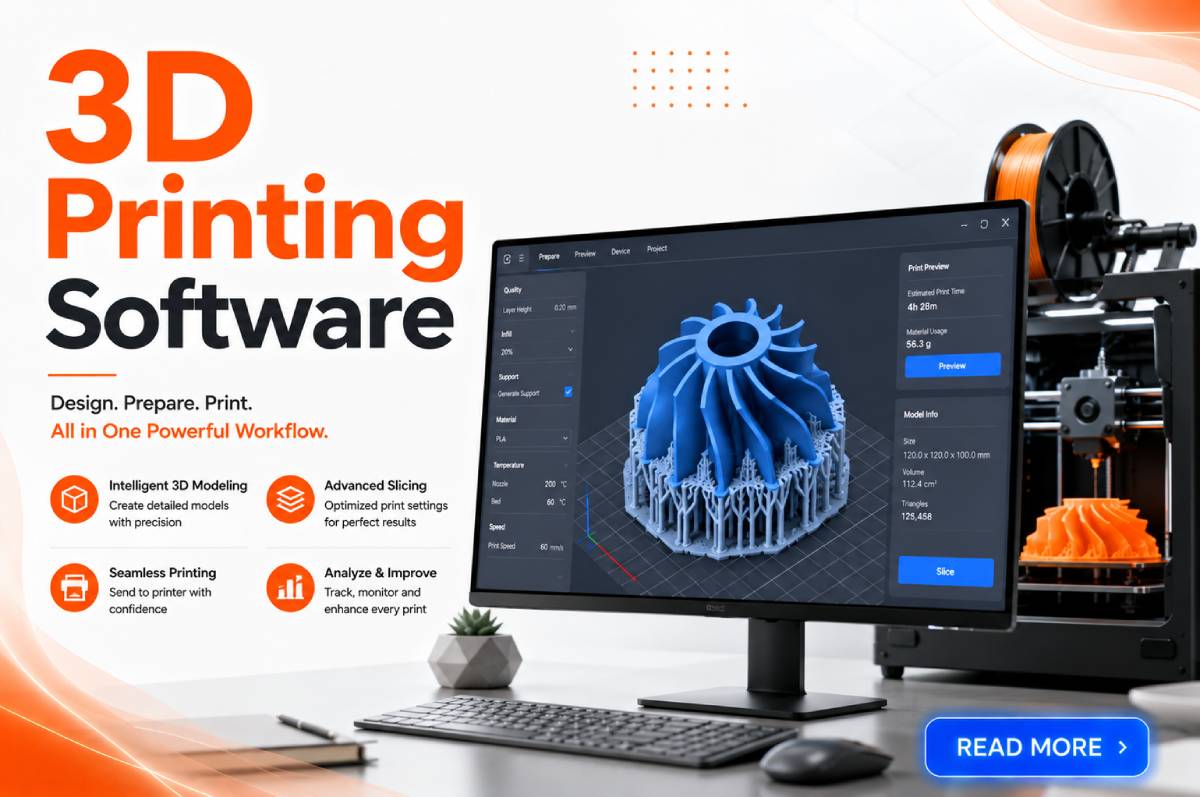
The 3D printing software market is emerging as a critical layer of digital manufacturing, enabling organizations to convert digital designs into production-ready physical components. The category supports modeling, optimization, print preparation and workflow management, positioning software as an increasingly important factor in manufacturing efficiency, product development and industrial competitiveness.
3D printing software encompasses a broad range of capabilities designed to support the additive manufacturing lifecycle. Platforms can assist with three-dimensional modeling, file preparation, slicing, print optimization, design validation and production management.
The technology serves multiple stakeholders, including product designers, engineers, manufacturers, architects and specialized fabrication businesses. As additive manufacturing expands beyond prototyping, organizations increasingly require software capable of handling more complex workflows and larger production volumes.
The growing software ecosystem also reflects increasing integration between design applications and manufacturing systems, helping companies reduce manual processes, identify potential printing issues and accelerate the transition from digital concepts to physical products.
The expansion of 3D printing software reflects the broader digital transformation of manufacturing. Additive manufacturing has progressed from an experimental and prototyping technology toward applications spanning industrial components, healthcare, aerospace, automotive, consumer products and customized production.
This evolution has increased the importance of software. A successful print depends not only on the hardware and material but also on the quality of the digital model, print parameters and production preparation process.
Software platforms can help organizations analyze designs, repair model errors, optimize geometry and prepare files for specific printing technologies. This creates opportunities to reduce development cycles, minimize failed prints and improve material utilization.
For enterprise leaders, the shift is significant because additive manufacturing can support localized production and rapid product iteration. As supply chains become more digitally connected, software may increasingly determine how effectively organizations scale these capabilities.
Industry analysis increasingly points toward software as a strategic component of additive manufacturing rather than simply a supporting utility. For engineering and manufacturing executives, the value lies in connecting design intelligence with reliable production processes.
Modern platforms can incorporate capabilities such as automated model checking, slicing, print optimization, file conversion and workflow management. These functions can help engineering teams identify problems before material and machine capacity are committed to production.
Another important consideration is interoperability. Enterprises often operate multiple CAD, simulation, printer and manufacturing systems, making compatibility a significant factor in software selection. Cloud-based collaboration can further support distributed engineering teams and manufacturing networks.
From an executive perspective, the strongest platforms will be those that combine usability with automation, scalability, security and integration. The competitive landscape is therefore likely to move beyond basic print preparation toward comprehensive digital manufacturing workflows.
For businesses, advanced 3D printing software can potentially shorten product-development cycles, improve design flexibility and reduce production inefficiencies. Manufacturers may also use these platforms to support customized products and smaller production runs that are difficult to justify through traditional manufacturing methods.
Executives evaluating solutions should consider compatibility with existing design systems, printer technologies, file formats, collaboration requirements and production volumes. Security should also remain a priority where proprietary product designs are transferred between teams or cloud platforms.
For policymakers, wider adoption raises questions around intellectual property, digital manufacturing standards, product certification and cybersecurity. As digitally transmitted designs become part of industrial supply chains, protecting design data could become increasingly important.
The next phase of 3D printing software is likely to focus on AI-assisted design, automated optimization, predictive print analysis and deeper integration with manufacturing execution systems. As companies move toward more distributed and customized production, software will play a central role in connecting digital design with physical manufacturing. The strategic advantage will increasingly belong to organizations that can turn these capabilities into faster, more reliable and scalable production.
Source: Crozdesk
Date: August 10, 2026


